Introduction
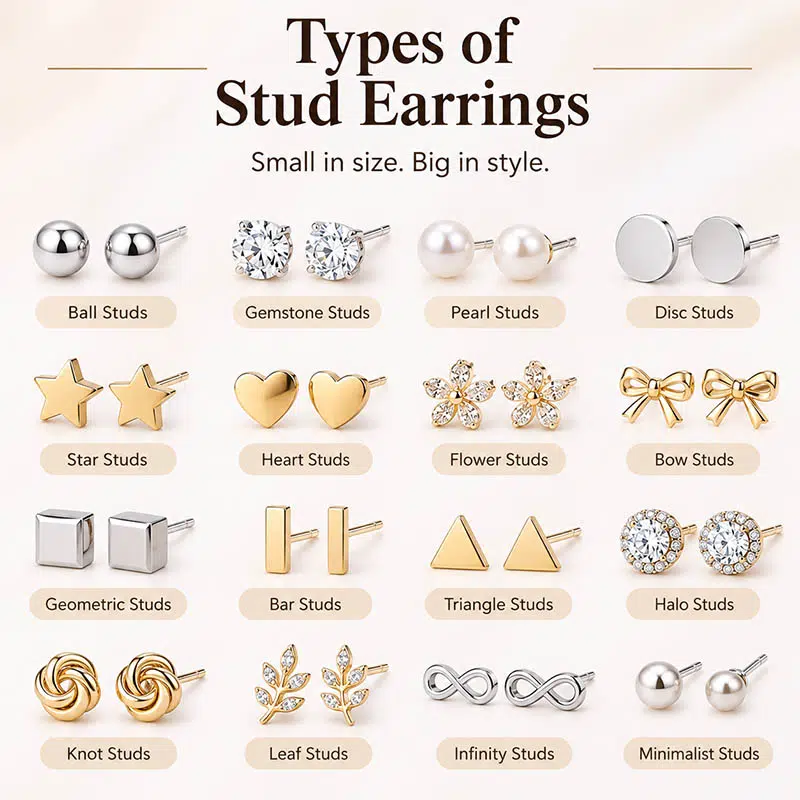
Stud earrings come in several styles, such as gemstones and pearls, geometric, floral, and metal designs. Each style has a unique combination of materials and decorative parts.
Knowing the different types of stud earrings can help jewelry brands target specific market segments. In this guide, there is an overview of the 15 popular stud earring designs, the types of stud earring backs you can use, materials you can consider for your brand, and what to check before production.
What Are Stud Earrings?
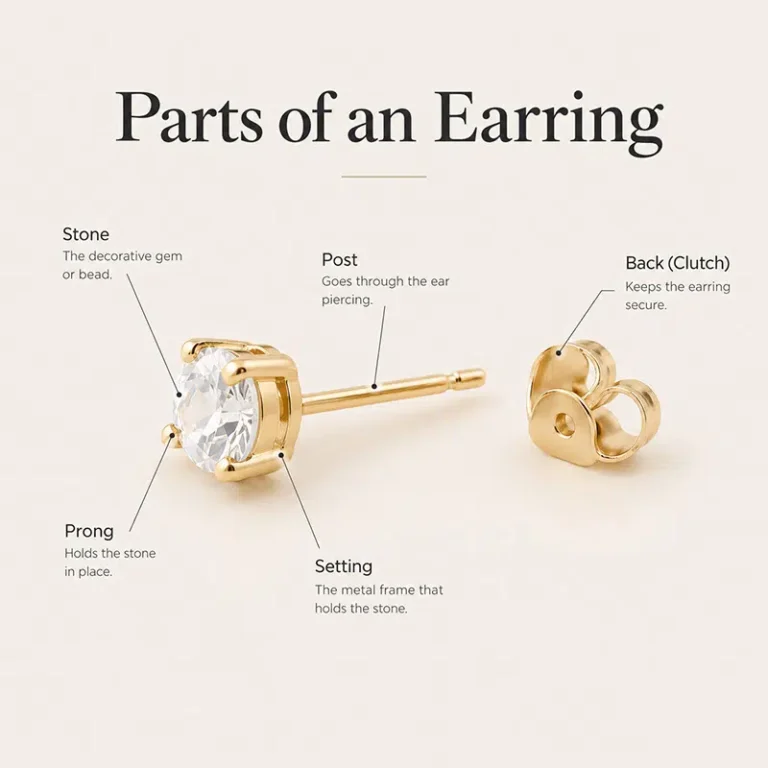
What is a stud earring? The stud earring features a decorative front fastened to a small and short post. The post goes through the earlobe and the backing of the earring holds it in place.
Key characteristics are:
- They are very close or sit directly on the earlobe.
- They have a small and compact design.
- They can be simple, decorative jewelry or have gemstones fitted in them.
- They can be worn everyday or on special occasions.
The major difference between studs and all other types of earrings refers to their structure.
| Type | Structure | How It Sits |
| Stud | Decorative front on a short post | Against the earlobe |
| Hoop | A loop of metal through the piercing | Wraps around or below the lobe |
| Drop | Decorative piece on a hanging link | Hangs below the lobe |
15 Popular Types of Stud Earrings
1. Diamond Stud Earrings
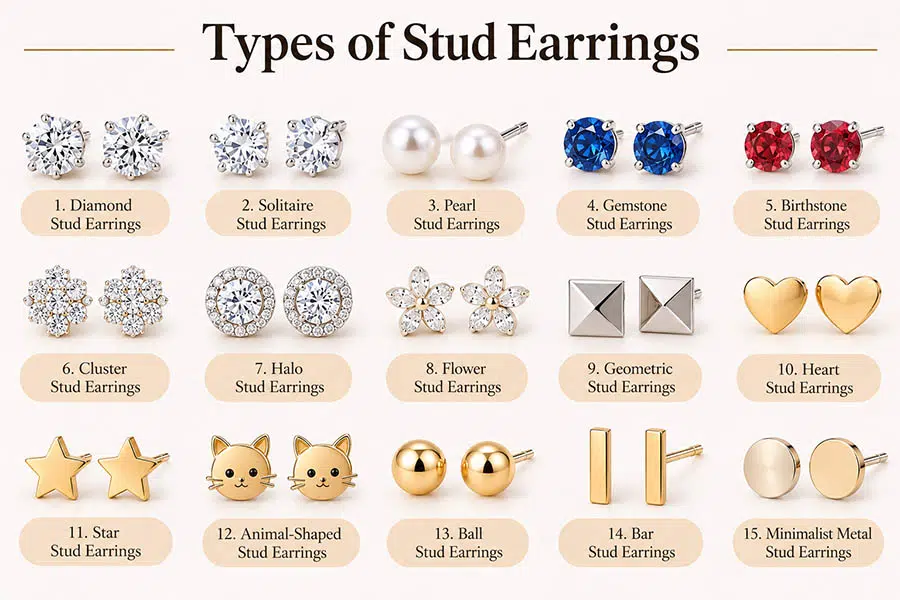
Diamond studs are designed to contain one or two diamonds on a post. They are quite tidy and therefore can be used in casual and formal collections of jewelry brands. Usually, prong and bezel settings are used. Diamonds and lab-grown diamonds can be used, as well as cubic zirconia can be used for a cheaper price.
2. Solitaire Stud Earrings
Solitaire studs consist of a single stone that is used as the main element of jewelry. The stone may be a diamond, cubic zirconia, or another type of gemstone, therefore, the word ‘solitaire’ describes the style, not the type of material. The shape, size, and setting of a stone will affect its appearance.
3. Pearl Stud Earrings
Pearl studs contain one pearl on a post. Round freshwater, cultured, and imitation pearls can be used for the production of studs. Smooth surface and soft luster of the pearl make it appropriate for use in formal, minimalist, and sophisticated collections. Often, customers request matching pairs, hence the importance of size and color.
4. Gemstone Stud Earrings
Gemstone studs contain such colorful stones as amethyst, sapphire, emerald, ruby, and topaz. Color, cut, and size of the stones affect the appearance. Makers set one stone alone or add small accent stones.
5. Birthstone Stud Earrings
Birthstone studs contain stones that are associated with certain months of the year (e.g., garnet – January, amethyst – February, sapphire – September). Birthstone studs are popular as customized gifts and are used in themed collections. The list of the most valued birthstones allows jewelry brands to select stones based on their cost.
6. Cluster Stud Earrings
Cluster studs consist of several small stones or elements grouped to form one whole larger size. It can be floral, round, or freeform shape. Cubic zirconia and colored stones are often used.
7. Halo Stud Earrings
Halo studs consist of a small stone surrounded by a ring of other stones. Halo studs add sparkle and make the central stone appear larger. Such a design is often used by manufacturers for diamonds and cubic zirconia. Placing numerous small stones requires some work, that is why we provide an additional time for halo design production.
8. Flower Stud Earrings
Flower studs arrange petals around a center piece. Such studs can be made of polished metal, enamel, pearls, or stones. They can be from minimal floral to more elaborate decorative ones and are often used in feminine and nature-themed collections.
9. Geometric Stud Earrings
Geometric studs include circles, squares, triangles, rectangles, and hexagons. Geometric studs are based on simple forms and lines and can be used in modern, minimalistic, and contemporary collections. Sharp edges require polishing and are controlled during sampling.
10. Heart Stud Earrings
Heart studs can be easily identified and associated with love, affection, and romantic gifts. Heart studs are made of polished metal, enamel, pearls, and stones. Brands can select either a simple full heart or a stone-covered one.
11. Star Stud Earrings
Star studs include five-pointed stars, celestial forms, or any other star-related designs. They are fun and bright in style. The process of production includes using polished metal, gold plating, and tiny stones.
12. Animal-Shaped Stud Earrings
Animal-shaped studs represent butterflies, bees, cats, turtles, and birds. The details are created with the help of metal casting, enamel color, and decorative stones.
13. Ball Stud Earrings
Ball studs are simply a round piece of metal. They come in many diameters and finishes and are made of stainless steel, sterling silver, brass, or gold-plated materials.
14. Bar Stud Earrings
Bar studs are made of a small horizontal or vertical piece of metal on a post. The straight lines give it a modern look. The makers provide polished, matte, and textured finishes.
15. Minimalist Metal Stud Earrings
Minimalist metal studs lack large-size gemstones and complex decoration. They can have the shape of small discs, tiny domes, abstract shapes, and simple curves.
Different Types of Stud Earring Backs
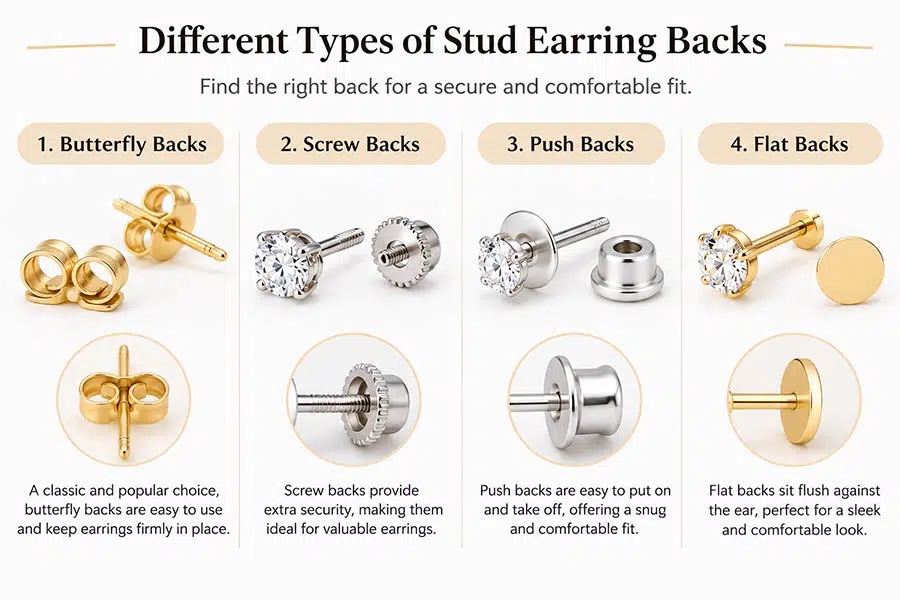
1. Butterfly Backs
Butterfly backs have a small metal piece with two curved wings that grip the post. Wearers put them on and take them off easily, so factories use them widely.
2. Screw Backs
Screw backs use a threaded post. The wearer twists the back into place. The fastening is secure, and putting it on takes slightly longer.
3. Push Backs
Push backs slide straight onto the post and stay in place through friction. They are simple to use and common on everyday studs.
4. Flat Backs
Flat backs have a flat disc behind the earlobe, paired with a threadless or internally threaded post. Cartilage and piercing jewelry often uses them because the flat rear surface sits against the ear. Suitability still depends on the design, fit, materials, and wearer. See the best metal for piercings for material choices.
Materials Commonly Used in Stud Earring Manufacturing
Stainless Steel
Stainless steel offers durability, corrosion resistance, and a lower cost, so it suits everyday fashion jewelry. Makers can add gold-colored PVD finishes. See the best stainless steel for jewelry.
Sterling Silver
Sterling silver is a popular precious metal with a bright silver look. Classic and fine jewelry lines use it often. Read what 925 silver is.
Brass
Brass bends into many shapes and accepts different surface treatments, so factories use it widely for decorative fashion pieces. Read if brass jewelry is good.
Factors to Consider When Developing a Stud Earring Collection
1. Design and Target Market
Design to your market segment, brand position, and product type. Different customers are interested in minimalist, classic, geometric, decorative, and fashion design types. It is necessary to understand customers beforehand when developing a collection. Having a jewelry brand strategy makes it easier to make decisions.
2. Material Selection
Different materials differ in price, strength, look, and manufacturing process. For example, stainless steel can be used to make strong fashion jewelry, brass allows to design decorative jewelry, and sterling silver has a different market segment. Learn more about stainless steel vs. sterling silver to determine your price level.
3. Size, Weight, and Proportions
Size and weight affect the final product. Stone size, decorative elements, post length, and general size are important. As we have experienced, a design that looks good on a screen may require a different size after the first sample. It is advisable to order a prototype to evaluate the size and comfort of wearing before starting mass production.
4. Earring Backings and Construction
Back and post type should be determined during the design. Butterfly, push, screw, and flat back can vary depending on the design, purpose, assembly requirements, and brand position. It is possible to have to order a new sample due to late decision.
5. Surface Finishes and Color Options
Polished, brushed, matte, and textured finishes have different visual appearances. Gold PVD coating and rose gold or black finishes provide different colors. PVD coating can be used to obtain a gold color in stainless steel. Determine the finish depending on the color and performance required. Learn more about the available PVD coating colors.
6. Customization and Manufacturing Feasibility
Shapes, sizes, materials, decorative elements, stones, and finishes can be individualized by the brand, but you should balance the design and manufacturing. Before finalizing the design, it is necessary to understand its complexity, requirements to jewelry mold, the manufacturing process, MOQs, and price. Experienced manufacturer can help to transform ideas into a ready-to-produce product.
Frequently Asked Questions About Stud Earrings
1. What Is the Difference Between Stud Earrings and Huggie Earrings?
Studs are earring designs worn directly on the lobe. Huggie earrings are small hoops that sit on the earlobe. They differ from each other because of the use of the hinge and loop forms respectively.
2. What Is the Difference Between Stud Earrings and Drop Earrings?
Studs are close to the lobe. Dangle earrings go from the lobe downwards. They are made differently than how they are worn.
3. What Is the Difference Between Post Earrings and Stud Earrings?
The term “stud earrings” stands for a category of design. A post refers to the vertical part of a stud that goes through the earlobe. Most of studs have posts as a design feature, but the two terms must not be used interchangeably.
4. Can Stud Earrings Be Produced in Small Quantities?
In most cases, the answer is yes. Minimum production quantities depend on the method of the manufacturer, materials, and complexity of the design. If the design does not require manufacture of new tooling, then less quantity should be needed as well. Visit our low MOQ jewelry manufacturer page for details.
Conclusion
Stud earrings come in a variety of styles and designs—from classic pearls and gemstones to geometric and minimalist metallic items. A good product line depends upon aesthetics, the choice of materials, production technology, surface treatment, as well as practicality.
OOTB Jewelry is a manufacturer located in China and specializes in stainless steel jewelry, while brass and silver are also produced. Our factory, located in Guangzhou, is intended for manufacturing customized jewelry.

 English
 French
 Spanish
 German
 Russian
 Turkish
 Portuguese