Introduction
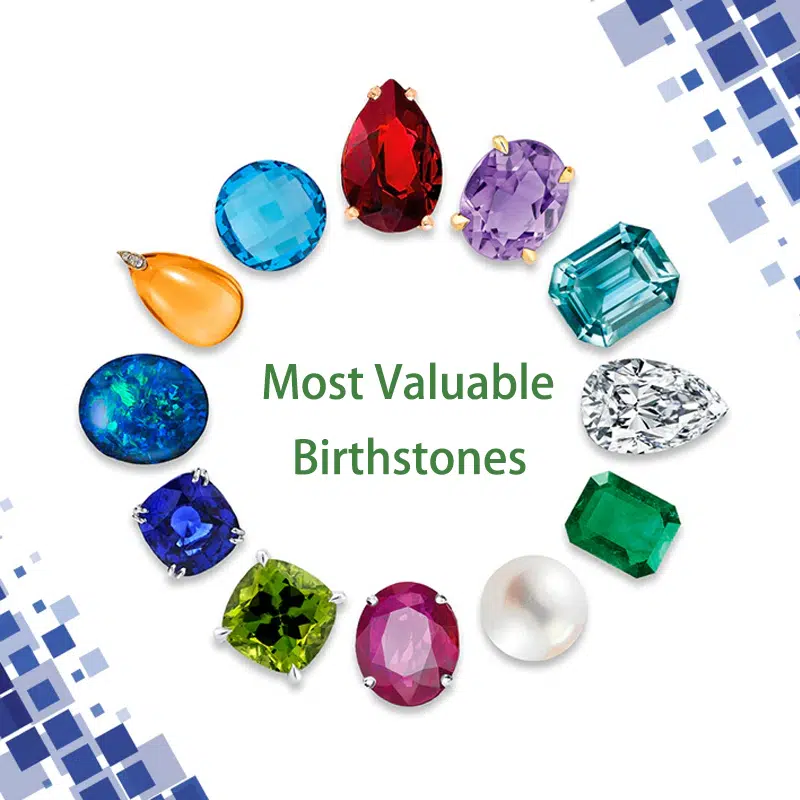
This guide provides a list of the most valuable birthstones ranked from highest to lowest value based on rarity and market value. In addition to telling you which stones cost more than others, the guide explains what factors determine a stone’s cost and how to select the birthstone that will meet your specific needs.
The complete chart contains information on the price per carat and the level of rarity, as well as the hardness rating of each of the twelve birthstones throughout the year, making it easy to make informed purchases either for personal use or in a retail setting.
The Top Tier: The Elite Gems (Highest Value)
Diamond (April)
Diamond ranks number one in the birthstone value list. With a Mohs scale hardness of 10, a diamond can only be scratched by another diamond. This durability makes diamonds ideal for everyday wear in rings and bracelets.
The color grade is the main factor affecting diamond costs. D-color diamonds are colorless and the most expensive. The scale drops by one letter from D and down to Z with each step down in value.
Other diamond colors are rare. Pink, blue, or even red diamonds cost significantly more than clear diamonds do.
Emerald (May)
Emerald is known for its intense green color. Colombian emeralds are very expensive due to their color saturation than emeralds from other countries. The green color is attributed to chromium and vanadium.
Emeralds have most inclusions referred to as “jardin”. The inclusions resemble little branches or moss or a garden. People are tolerant with the inclusions as the proper emeralds are very scarce.
Crystal structure makes emeralds more brittle compared to sapphires and diamonds. Jewelers will use protective settings when putting emeralds on gold fillings to avoid chipping.
Ruby (July)
Ruby’s red color comes from chromium. Its most desirable color is called “pigeon’s blood” red, which is pure red with a touch of blue. Burmese rubies from Myanmar are the most desirable rubies because they have the ideal color.
There is a history of rubies in crowns and other important jewelry for centuries. Monarchs have valued rubies as much as diamonds. This history is reflected in current values.
Sapphire (September)
Sapphire comes in various colors, with deep blue being the most famous. The velvety blue color of Kashmir sapphires is highly sought after by collectors.
Padparadscha sapphires are known for their distinctive pink-orange hue. The name refers to a certain word in Sinhalese meaning “lotus flower.” This type of sapphire is one of the rarest and more expensive than the blue ones.
Sapphire is 9 on the Mohs scale. This high rating makes it very suitable for everyday jewelry. Many sapphires are used in engagement rings instead of diamonds.
The Rare and Coveted Gems (Mid-to-High Value)
Alexandrite (June)
Alexandrite displays different colors depending on the light source. When viewed using daylight or fluorescent illumination, it appears green. When viewed using incandescent lighting, it appears red or purplish-red. This is due to chromium located within the crystal.
The rarest alexandrite is the Russian material from the Ural Mountains. The Ural mines produced the best color-change alexandrite, however, they are now mostly exhausted. Current production sources are in Brazil, Sri Lanka, and East Africa.
The majority of alexandrite on the marketplace is created synthetically, it is much cheaper but doesn’t retain its value like the natural material does.
Pearl (June)
Natural pearls occur when an oyster has an irritant. This happens naturally without human intervention. They are rare today. Cultured pearls are the current form. Farmers introduce the irritant. They have a huge price difference.
Shape defines the value of pearls. The rounder the pearl, the better the quality. Round and perfect pearls are rare. They have the highest price. Irregular pearls, baroque, have less price.
Highly Desirable Gems (Steady Value)
Garnet (January)
People know the red garnet, which costs $20 to $100 per carat. But certain rare garnets can cost much more. Demantoid garnet has an intense green color and is firey (shows rainbow flashes). “Horsetail” inclusions (thin needles) increase the price.
Tsavorite garnet is green and similar to emerald. It comes from Tanzania and Kenya. Clear stones over 2 carats can cost $2,000 per carat. Price depends on color and clarity.
Tourmaline (October)
Tourmaline occurs in every color. Pink, green, and blue tourmaline are ubiquitous and cheap. Not Paraíba tourmaline. Paraíba tourmaline is unusual because it’s the only form of tourmaline that has copper, which gives it a shocking neon blue or neon green color that no other gemstone has.
Paraíba tourmaline was first mined in Brazil in the nineteeneighties. The original mine had small production. Similar copper tourmalines were later identified in Mozambique and Nigeria. The Brazilian Paraíba still has the highest value. The African Paraíba has less value but remains expensive compared to other forms of tourmaline.
Peridot (August)
Peridot occurs in volcanically active regions. The color is due to iron in the structure. In contrast to certain gemstones colored by trace elements, the green hue of peridot is inherent.
Deep green peridot, low in yellow, is the most desirable. Large peridots over five carats are worth more on a per-carat basis than smaller ones. Peridot varies in clarity, size and color. Most peridot comes from Arizona, China and Pakistan.
Birthstones Price, Rarity Level and Mohs Scale Chart
| Month | Birthstone | Price per Carat | Rarity Level | Mohs Hardness |
| January | Garnet (Demantoid) | $500 – $2,000 | Medium-High | 6.5-7.5 |
| February | Amethyst | $20 – $100 | Low | 7 |
| March | Aquamarine | $100 – $600 | Medium | 7.5-8 |
| April | Diamond | $3,000 – $50,000+ | High | 10 |
| May | Emerald | $800 – $10,000+ | Very High | 7.5-8 |
| June | Pearl | $50 – $5,000 (cultured) | Medium | 2.5-4.5 |
| June | Alexandrite | $5,000 – $20,000+ | Very High | 8.5 |
| July | Ruby | $1,000 – $15,000+ | Very High | 9 |
| August | Peridot | $50 – $500 | Low-Medium | 6.5-7 |
| September | Sapphire | $800 – $10,000+ | High | 9 |
| October | Opal | $50 – $1,000 | Medium | 5.5-6.5 |
| October | Tourmaline (Paraíba) | $5,000 – $20,000 | Very High | 7-7.5 |
| November | Citrine | $10 – $50 | Low | 7 |
| November | Topaz | $25 – $400 | Low-Medium | 8 |
| December | Turquoise | $10 – $200 | Low-Medium | 5-6 |
| December | Tanzanite | $300 – $1,200 | Medium-High | 6-7 |
| December | Zircon | $50 – $200 | Low-Medium | 6-7.5 |
Factors That Determine a Birthstone’s Value
The 4 C’s
Carat weight
Gemstones’ masses are determined by the carat. A gemstone’s size has an exponential rather than linear correlation with its price. For instance, a two-carat ruby, has a value of three to four times greater than a ruby of one carat weight. This is attributed to the fact that a larger-sized, clearer gemstone is much rarer.
Clarity
Blemishes and inclusions determine the clarity of the gemstone. Fewer inclusions equate to higher value for the gemstone than those with larger amounts of inclusions.
Color
The most important characteristic of colored gemstones is their color. The ideal color of a gemstone will vary by type. The ideal color for rubies is pure red and deep blue for sapphires. In addition, the color should appear uniformly throughout the gemstone and not be broken into light and dark sections. Saturation is used to describe how vivid the color appears. The greater the saturation, the greater the value of the gemstone.
Cut
The cut influences light performance. The better the cut, the more shine and fire there is. A poorly cut stone will appear lifeless even if the rough material is good. Correct angle facets must be maintained.
Treatments
Heat treatment is typical for rubies and sapphires. Treated stones are 30-70% less expensive than untreated stones. Clarity treatments fill in surface fractures with oil or resin. A gemological lab certificate indicates if a gemstone has been treated or not. Be sure to request a certificate for expensive stones.
How to Choose the Right Birthstone Jewelry?
For Jewelry Business
Your Market decide on the stones to carry. Do you have any research on the market in your area? It’s also good to know which designs are renowned particularly for sold jewelry.
Metal Types and stone value has to match. E.g. Diamond requires gold or platinum. 925 is okay for fashion jewelry but not for fine jewelry. Metal color changes the appearance of stones: yellow gold brings out the tone of the ruby while white gold and rhodium plated metal brings out the true blue of the sapphire.
The Cut and Shape depends on the type of jewelry. Round stones for rings. Oval and/or cushion cut for pendants.
For Jewelry Lover
Find the gemstone that corresponds with your birth month to provide you with a personal connection. If the birth month stone is high-end, look for less expensive options.
Budgeting will influence how much quality you can buy; often a smaller, higher quality stone will have beaten a larger lower quality stone visually.
Conclusion
Diamond, ruby, emerald, and sapphire are always top-value birthstones. They have high prices associated with real scarcity, toughness, and continued popularity. An item’s value is determined by its source, color quality, clarity, size, and treatments.
Contact OOTB for inquiries about custom birthstone jewelry. Our factory in Guangzhou works with all types. We can manufacture to your requirements.
Frequently Asked Questions
What Are the Cheapest Birthstones?
Amethyst, citrine, and turquoise are the least expensive gemstones. Amethyst, with its lovely purple color, costs around $20-$100 per carat. This gemstone has large deposits in Brazil, so it’s readily available. Citrine costs $10-$50 per carat. Turquoise ranges in price from $10-$200 per carat. These gemstones are relatively inexpensive and can be obtained at a low price. They also look good and have decent hardness.
What Are the 3 Rarest Birthstones?
Diamond, ruby, and emerald rank as the three most precious birthstones. All three are categorized as the “precious stones” in the world of gemstones. The restricted availability of diamond and its outstanding hardness qualities make it both valuable and rare. Ruby of the highest grade with the pigeon’s blood shade is rarer than diamond. The jardins-free kind of emerald is extremely difficult to locate.
 English
  French
  Spanish
  German
  Russian
  Turkish
  Portuguese