

Introduction: Addressing the “Thinness” Anxiety
What is the best PVD coating thickness for jewelry? The question that customers like to ask most is, “Is 0.03m too thin?”
It’s a fair question. Thicker is generally better – except where PVD is concerned. PVD is a thin-film deposition process. It is not a “thick paint” coating. It adheres, nearly quite literally, to the metal.
Here’s what surprises most people: a layer of 0.05 μm titanium nitride (TiN) is harder than a layer of 1μm soft gold. This article explains the how and why and, more importantly, how to apply the knowledge when ordering your PVD jewelry through a manufacturer.
Technical Deep Dive: Why 0.03 to 0.08 µm Is the “Sweet Spot”
Precision Over Bulk
PVD coating in thicknesses of 0.03-0.08 μm follows all micro details of the jewelry surface. This dimensional excess is critical for fine engravings or layered textures. With the application of a thick layer of coating, the micro details are mixed up; they are rounded, and they become less apparent. The lost wax casting process creates those precise details, and the PVD preserves these microdetails.
The Hardness Factor
Vickers hardness is a measure of the scratch resistance of a material. Higher values indicate a harder surface.
| Coating Type | Hardness (HV) |
| Traditional Gold Plating | 150 – 250 HV |
| Steel (reference point) | 500 – 800 HV |
| PVD Titanium Nitride (TiN) | 1,500 – 2,500 HV |
| PVD Zirconium Nitride (ZrN) | 1,800 – 2,200 HV |
Gold plating is soft. Everyday activities. Banging rings on surfaces and wearing bracelets quickly wears away the finish. The PVD coating is much harder than the steel it is applied to. That’s why gold-plated jewelry tarnishes while PVD jewelry maintains its color for a long time.
Dense Beats Thick
During the process of vacuum deposition at 0.03-0.08 μm, atoms are blithely squeezed with no voids in between. The result is a coating that has a very high surface density. The density, not the thickness, affords scratch and wear resistance.
A PVD coating of 0.05 µm thickness will display better scratch resistance than a soft gold coating 50 times thicker than itself. This is the principal advantage of thin film technology. When reviewing the performance of PVD jewelry over time, the thickness of the coating will be less important than the quality of deposition.
Choosing the Foundation: 304 vs. 316L Stainless Steel
The performance of a PVD coating is based on the substrate and the type of coating; a high-quality coating can have a poor performance if it is applied on a weak substrate.
Here is a comparison of the two main types of PVD coatings:
304 Stainless Steel
- Cost: Lower cost and works well for fashion jewelry and the production of large quantities of products
- Performance: Provides good wear resistance for the average user’s use of the product
- Disadvantages: Limited resistance to salt and sweat when used for extended periods
- Best Uses: Trend items, seasonal collections, and wholesale orders that are of sufficient quantity.
For more information on the performance characteristics of different grades of steel, see “Best Stainless Steel Grades for Jewelry Manufacturing“.
316L Stainless Steel (Surgical Grade)
- The presence of molybdenum provides 316L with excellent resistance to rusting and corrosion.
- The adhesion of PVD coatings to 316L stainless steel is significantly greater than that of traditional materials. PVD does not typically come off or peel from the surface of 316L after being exposed to pool water or body sweat multiple times.
- Limited nickel release of 316L; therefore, it is classified as hypoallergenic and safe to wear against sensitive skin.
316L is the most commonly used grade of stainless steel for the production of nickel-free jewelry lines, as well as for any product that is marketed as being safe for use against the skin. If your customers plan on wearing their jewelry while exercising or bathing, 316L is the correct choice.
The “Bond” vs. The “Layer” — Visualizing the Difference
| Electroplating | PVD Coating |
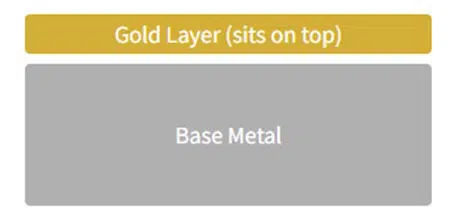 | 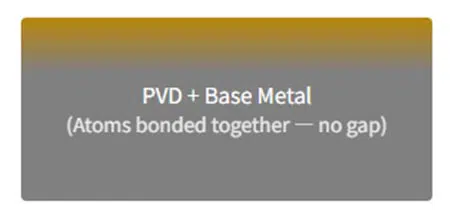 |
| Gap between layers: Moisture gets under, and flaking occurs | No interface: Coating is part of the metal surface |
Electroplating applies metal ions to a surface — it’s a thin layer that’s on top of the surface, as opposed to being integral to it. A scratch creates a seam for water to enter, and the layer begins to peel off.
PVD is different. Cathodic arc evaporation or magnetron sputtering in a vacuum chamber sends metal particles hurtling into the base at high speed. There’s no air gap. There’s nowhere for moisture to ingress. That’s why ion-plated jewelry and PVD behave very differently from a standard rhodium and gold-plated item.
Conclusion: The Professional Choice
The 0.03–0.08 μm PVD coating range on stainless steel gives you the best color-fast, highest quality, long-lasting finish, cheaper than any other product available today for jewelry making. Harder than soft gold plating, dense enough to seal out moisture, and thin enough so you can see the detail in every design, while being moisture and steam-proof.
If you are sourcing PVD stainless steel pieces or want custom designs produced at scale, OOTB Jewelry — a jewelry manufacturer based in Guangzhou, China — offers over 50,000 styles and 10 years of export experience. Send your design or request a catalog directly through their stainless steel jewelry manufacturing page.
FAQs: What Your Clients Really Want to Know
Will PVD Stainless Steel Jewelry Turn Skin Green?
304 and 316L stainless steel are chemically inert – it does not contain copper or zinc, which is responsible for the green stain. PVD coating itself is inert and does not react with water, sweat, or skin. This is not true for other metals, such as brass or copper that results in green discoloration of the skin.
Is PVD Stainless Steel Jewelry Waterproof?
Due to its ability to produce a uniform coating that has no gaps, the vacuum deposition process creates an impervious seal on the original metal. As a result, water cannot access the steel below the surface of the stainless steel.
This is why PVD stainless steel meets all salt spray testing criteria as outlined by ASTM B117 and has the ability to take a shower wearing stainless steel jewelry without damaging the surface finish or being damaged by water.
Why Not Make It 5µm Thick?
Thicker PVD sounds better, but it has its problems in reality. More internal stress on the coating, at a certain thickness, and the coating becomes more brittle. It will crack on bending/impact and not hold.
The range of 0.03-0.08 μm is the best synergistic effect to manage coating stickiness, ductility, and coating hardness. More volume leads to lower endurance instead of more.


 English
  French
  Spanish
  German
  Russian
  Turkish
  Portuguese