Introduction
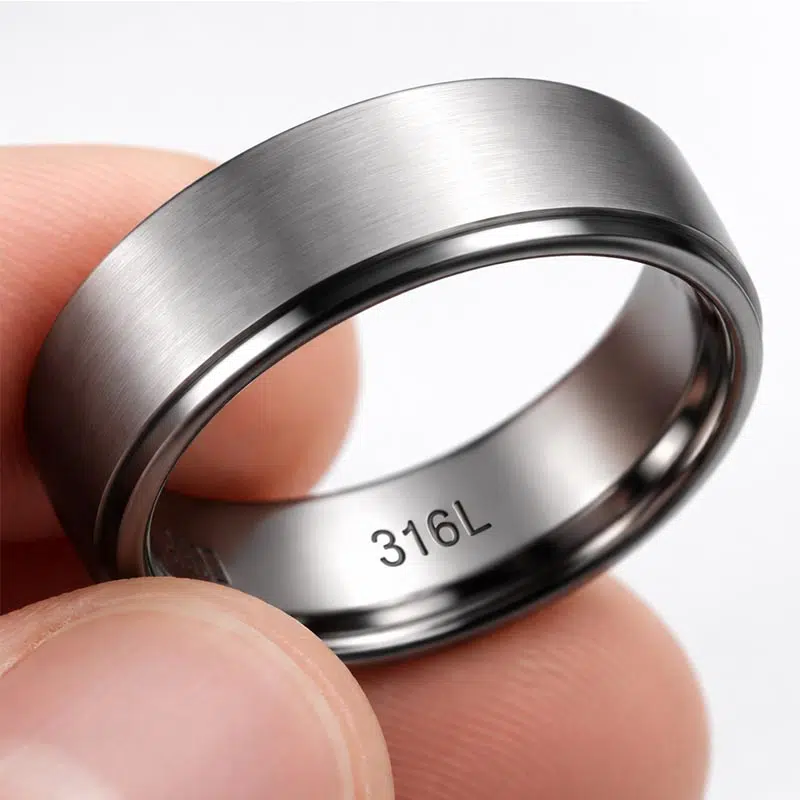
When you look at a piece of jewelry that has “316L” written on it, this is not the brand name or style of the piece; this is a type of stainless steel material itself.
Here is a blog post on what does 316l mean on jewelry, how the metal is built at a chemical level, why it is a better material than most alternatives, and some noteworthy points on sustainability. You will also find a direct comparison of 316L to 925 sterling silver and 304 stainless steel to understand it better.
Technical Definition: Breaking Down the “316L” Stamp
“316” indicates the presence of molybdenum — a metal included in the steel composition in a concentration of 2-3% — according to the AISI (American Iron and Steel Institute).
The key differentiator between 316-grade stainless steel and regular 304-grade stainless steel. 304 does not contain molybdenum and is therefore reactive to seawater and sweat.
While 316L contains molybdenum, which makes the steel immune to pitting.
The definition of the L is low carbon.
It means that the concentration of carbon is lower than 0.03%. Low carbon is important, especially in production. This is because when steel gets exposed to high heat, during welding, casting, or soldering, it can interact with chromium and diminish the protective cover on the metal. Low carbon avoids this interaction. The layer is uniform all over the process.
How to Test Whether Your Jewelry is Made of 316L or Not
Austenitic Cr-Ni stainless steel 316L has an atomic arrangement of the metal that causes it to be non-magnetic at room temperature (“normal conditions”).
The quickest, easiest, and most effective way to verify if a sample you have is actually 316L stainless steel is with a magnet:
- Weak or no attraction to the magnet is a characteristic of genuine 316L.
- A strong attraction to the magnet indicates that the sample is most likely either a 200- or 300-series alloy (but not 316L).
IMPORTANT: After going through certain processes, like cold working via stamping or forming, an item that was originally made from 316L may develop a very limited amount of magnetic attraction. This small, very limited attraction does not mean the material is fake; the attraction should be much less than that of typical iron magnets.
Core Benefits for Jewelry Manufacturing
1. Hypoallergenic & Medical Grade
316L stainless steel is often used in the production of surgical tools, bone fixation screws, and body piercing jewelry due to its biocompatibility. Nickel in 316L stainless steel is chemically bound to the metal matrix and does not leach out of the matrix, making 316L jewelry safe for all skin types, including those who have a sensitivity to cheaper metals.
2. Extreme Durability & Aesthetics
- Completely waterproof and sweat-proof — fully rustproof and oxidation resistant.
- No green skin from copper oxidation since no copper or brass is present in the metal.
- Different surface finishes — it can be customized into polished mirror finishing or made in brushed matte finishing.
3. The Molybdenum Advantage
The 2-3% molybdenum in 316L is specifically added to handle environments that would damage the jewelry:
- Saltwater — ocean swimming, sea air, coastal humidity
- Chlorine — swimming pools, hot tubs
- Acidic sweat — daily wear, exercise, hot climates
SS Jewelry exposed to such conditions without molybdenum can become damaged by pitting, which is the formation of small holes on the surface that progressively enlarge in size and depth, causing a permanent defect. Molybdenum provides structural protection in this regard.
4. PVD Plating Compatibility
316L is the standard substrate for PVD (physical vapor deposition) coating. Using a vacuum chamber, a thin layer of metal – typically 18K gold or black titanium – is adhered to the steel substrate at an atomic level.
Because 316L has such a stable surface, the coating adheres well and will not chip, bubble, or peel off as it sometimes does when used on softer metals. This is why it is the metal of choice for big-volume jewelry manufacturing when the color-fastness of the finish is a consideration.
Read more about PVD plating and how long does PVD Jewelry last.
5. Durability vs. Precious Metals
| Properties | 316L Stainless Steel | 925 Sterling Silver |
| Mohs Hardness | 5-6 | 2.5-3 |
| Scratches Easily? | No | Yes |
| Tarnishes in Air? | No | Yes |
| Needs Polishing? | Rarely | Regularly |
| Safe for Display Cases? | Yes — zero maintenance | Needs anti-tarnish care |
For retailers, this is significant. Sterling silver oxidizes when exposed to air and requires consistent maintenance. 316L sits in a display case for months without any change.
316L vs. Competitive Materials
| Property | 316L Stainless Steel | 925 Sterling Silver | 304 Stainless Steel |
| Durability | Excellent | Moderate | Good |
| Maintenance | Very low — rinse and dry | High — regular polishing needed | Low — occasional wipe down |
| Waterproof | Full — ocean, pool, sweat | Tarnishes with moisture | Partial — no molybdenum |
| Hypoallergenic | Surgical Grade | Can cause reactions | Generally safe, not certified |
| PVD Compatible | Best substrate | Not standard | Works, but less stable |
| Cost | Low-medium | Medium-high | Low |
Maintenance, Storage & Safety
Cleaning Method:
- Rinse with warm water and a little mild detergent
- Use a soft brush (e.g., toothbrush) to clean the insides of settings, chains, and around engraved areas
- Dry with a soft cloth or air dry
Things to Avoid:
- Harsh Chemicals — Acids or bleach (or any other type of industrial cleaning) will remove the layer of chromium oxide that protects the stainless steel.
- Ultrasonic cleaners that have a harsh chemical cleaning solution.
Storage:
- Store 316L items in individual soft pouches.
- 316L is much harder than silver or gold and therefore has the potential to scratch softer metals if they are stored together.
- This also applies to retailer display cases, as storing items separately will help prevent surface damage to adjacent items.
Environmental & Ethical Impact
316L stainless steel has a lighter environmental footprint than precious metals in two key areas:
Mining and processing gold or silver metal requires a significant amount of energy, land disruption, and chemical treatment for refinement. The production of stainless steel, alloy 316L, usually consumes less energy per kilogram than that of the stainless alloy.
316L is recyclable all the way through. At the end of a product’s life cycle, even though it was melted, there’s no loss in the essential qualities. For brands trying to push a closed-loop material strategy for building sustainable product lines, 316L is the best option. Moreover, eco-conscious customers are receptive to that.
Conclusion
316L is definitely the material used with the highest feasibility rate among all other materials for the production of jewelry with high volume. It brings together the corrosion resistance of marine-grade steel with the skin safety of surgical-grade metal, and the PVD coating is unbeatable when it comes to adherence. It does not tarnish, does not pit, and does not cause skin reactions for the vast majority of wearers. For the retailers, this means reduced returns, less count of displays, and some totally worry-free jewelry pieces that can be worn every day.
If you want to customize stainless steel jewelry with your own designs, OOTB is a jewelry manufacturer based in China with over 10 years of export experience and more than 3000 styles available.
Frequently Asked Questions (FAQs)
Is 316L stainless steel magnetic?
No. 316L in its annealed condition should be austenitic and not magnetic. If a part marked ‘316L’ has a strong attraction to a magnet, it’s probably made from an inferior alloy material that has a higher carbon content. Very weak magnetism from stamping (cold working) is acceptable and normal.
Can I wear 316L in the ocean or pool?
Absolutely. Molybdenum is designed to make the metal resistant to chlorides, such as those contained in saltwater and pool chlorine. Consequently, it’s one of the very few jewelry materials that can be exposed to these conditions without experiencing any surface damage.
Does 316L contain nickel?
Yes, it is between 10-14%. However, the chromium oxide coating of the stainless steel surface prevents nickel from ever coming into contact with anyone’s skin. This is why 316L is considered hypoallergenic and is the typical recommendation for nickel allergy and surgical implant scenarios.
Will it turn my skin green?
Green skin stains are from copper oxidation – a chemical reaction that occurs with metals containing copper, such as brass in the presence of water and skin. As 316L has neither copper nor brass, this will not occur. For more on why copper stains skin green, read how to prevent copper from turning skin green.
Is 316L the same as “surgical steel”?
“Surgical Steel” is a class term, it does not refer to a specific alloy. 316L is the most common specific grade under the category used for surgical instruments and body piercings because of its resistance to corrosion and biocompatibility. When a product says “surgical steel,” 316L is the grade it should be.
 English
  French
  Spanish
  German
  Russian
  Turkish
  Portuguese