Introduction: The Science and Business of Non-Tarnish Jewelry
Jewelry brands and retailers have to make certain that their products are tarnish-free — it is a matter of customer satisfaction, return rates, and how much the pieces are worth.
Customers will abandon brands if your products tarnish after a few weeks.
This all-encompassing guide describes what jewelry does not tarnish, from metal to finish. We also list the most common ones that tarnish and present prevention advice.
Whether for bulk manufacturing or selecting items for retail, this guide will assist you in choosing the right materials for your jewelry.
Understanding Jewelry Tarnishing
What Is Tarnish?
Tarnishing is caused when atmospheric elements, such as oxygen (oxidation) and sulfur compounds, react with metals. These chemical reactions create a thin layer of chemical buildup on top of the metal surface, which causes a dull, black, or dirty finish. This can significantly reduce the shine of an item.
Common Triggers
- Humidity & Moisture – Water will cause metal to oxidize faster than if it hadn’t been exposed to water.
- Sweat – Skin acids react with copper-mineral-based metals and cause them to oxidize quickly
- Perfume/Hairspray – Perfume and hairspray have chemicals in them, which cause premature damage to the surface of metals.
- Lotions and Sunscreens – These products leave a residue on the top of the metal that traps agents that will oxidize the metal.
- Chlorine – Heavy in pool and tap water; oxidizes with metals.
- Sulfur – Found in polluted environments; Causes Silver to oxidize.
Top Metals That Do Not Tarnish or Oxidize
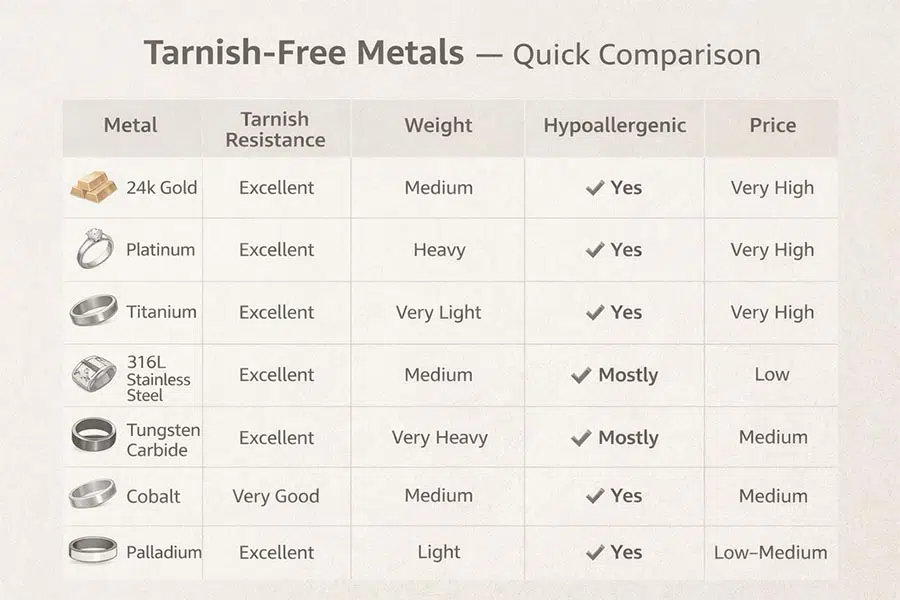
Solid Gold (14k, 18k, and 24k)
Pure 24k gold does not tarnish because it is not chemically reactive (does not react with oxygen or sulfur). Alloyed 18k and 14k gold’s resistance to tarnishing depends on the gold content of the alloy.
| Karat | Gold Content | Tarnish Risk |
| 24k | 99.9% | None |
| 18k | 75% | Very Low |
| 14k | 58.5% | Low |
| 10k | 41.7% | Moderate (more copper) |
Lower gold content means more copper or silver, which may discolor in places due to sweat over time. Read about how to pick gold that does not tarnish to get more information.
Platinum
Platinum is a precious metal. It does not rust, oxidize, or become yellow – ever. Its shimmering white color is permanent without plating or treatment. It is the hardest metal used in fine jewelry and will last a lifetime. The cost is the downside – platinum is more expensive than most precious metals.
Titanium
Saltwater, sunlight, and body chemistry do not cause any reactions with titanium. It is light, super strong, and one of the choices is absolutely nickel-free jewelry, which is fully hypoallergenic. Titanium jewelry is favored by wearers with active lifestyles or those who have sensitive skin because it is known to give good results in these cases.
Stainless Steel
Stainless steel contains chromium that produces an oxide layer on the surface of the material. The layer prevents moisture and air from coming in contact with the surface of the stainless steel, preventing rust, staining, and corrosion. It is inexpensive, scratch-resistant, and resistant to water, a good material for jewelry-making.
For use in ocean waters, 316L stainless steel is the way to go — it has a greater proportion of molybdenum, which provides more protection against saltwater corrosion. Read more about whether stainless steel jewelry is waterproof and how to choose the right stainless steel for jewelry.
Tungsten Carbide
Tungsten carbide is among the most durable materials in jewelry. It is non-scratchable, does not corrode, and keeps its shine forever. Thus, it is one of the best options for wedding rings. The one problem is that the size can not be adjusted.
Cobalt
Cobalt is white in color by nature and does not need rhodium plating to appear nice and shiny. It is highly resistant to tarnishing and falls within the same performance range as platinum, at a significantly lower price. It is an excellent choice for white metal jewelry that requires a clean appearance for extended periods.
Palladium
Palladium is in the platinum family of metals, so it does not tarnish like platinum.
It is lighter in weight than platinum, entirely hypoallergenic, and requires no rhodium plating (as compared to white gold vs. yellow, which does need regular replating). Palladium is well-suited for brands in need of a premium white metal at an affordable price.
Ceramic
Jewelry made with technical ceramic is not an alloy of metals but rather is made from a high-temperature compressed sintered material; it will not oxidize or tarnish at all.
The coloration of the technical ceramic is generally black, white, or dark blue and runs the entire length of the piece, not just on the surface part of the object, so it stays permanent. Also, technical ceramic is very lightweight and is scratch-resistant.
Understanding Gold-Alternative Finishes
Gold Filled Jewelry
Gold-filled jewelry involves a layer of karat gold that is pressure-bonded to metal under heat and pressure.
This is different from gold-plated – a gold-filled piece has a 50-100 times larger gold layer. Under normal circumstances, you can expect a gold-filled piece to last more than 10 years before any metal shows through. For a similar product comparison, visit gold-filled vs gold-plated.
PVD (Physical Vapor Deposition) Coating
PVD is a vacuum-coating process for application onto the surface of mostly stainless steel. Under vacuum conditions, metal vapors are amalgamated and bonded on a molecular level with the jewelry surface.
The standard deposition is circa 0.05 microns, ten times the performance in scratch resistance and colorfastness than ordinary electroplating. The finishing is waterproof, sweat-proof, and tarnish-resistant. With proper maintenance, it can bear up to 2 years of wear.
Rhodium Plating
Rhodium is ideal for white gold jewelry and sterling silver items. This gives a hard and shiny, reflective surface of a kind that is more difficult for the metal underneath to make contact with air. Its weakness is that it does not last; the rhodium plating is very likely to get scratched and rubbed off with time, especially on rings and other areas where skin contact is most frequent. In such cases, it is uncovering the metal underneath.
Metals That Are Prone to Tarnishing (For Comparison)
Sterling Silver (S925)
Sterling Silver (S925) is 92.5% silver and 7.5% copper. Because of that copper, it tarnishes with sulfur in the air and adsorbs that dark gray or black patina. This is because the higher the copper content, the more it tarnishes. Sterling silver is still one of the most favored materials for jewelry-making because of its aesthetic value and its price, but it needs to be cleaned regularly to maintain its shine.
Brass, Copper, and Bronze
The oxidation rate of these base metals is very fast. Copper reacts quickly to the acids found in sweat, which causes a green stain to form on the skin from the combination of copper oxide and moisture from the skin. Using brass for fashion jewelry may be suitable, although it will require a protective coating to help prevent oxidation.
Maintenance and Prevention Strategies
Proper Storage
- Store your jewelry in a cool and dry location away from moisture/humidity
- Use plastic zip-lock bags or containers that are personal (such as silver and copper jewelry)
- Put tarnish preventative strips in your storage containers – they will take in the excess sulphur from the temperature.
- Store each piece of jewelry separately so they do not scratch each other.
Chemical Avoidance
Remove jewelry before:
- Swimming in chlorinated pools or the ocean
- Applying perfume, lotion, or sunscreen
- Using household cleaning products
- Working out (prolonged sweat exposure)
Cleaning Protocols
- Non-deteriorating metals (gold, platinum, stainless steel) can be cleaned using a mild soap and water solution as well as wiped dry with a soft cloth.
- For silver or copper- based metals, you will need either a silver polishing cloth or silver cleaning solution.
- For coated surfaces (PVD, gold-filled), it is best to avoid using abrasive cleaners since they will take off the surface coating.
Conclusion: Strategic Material Selection
Choosing the adequate metal for your jewelry according to its affordability, application, or client demands is important. The knowledge of these material properties allows brands to make confident claims and provide care instructions to consumers.
Contact OOTB Jewelry, a China jewelry manufacturer with 10 years of export experience and 3000+ styles, to get sourcing alternatives to match your budget and quality requirements.
Frequently Asked Questions
Does White Gold Tarnish?
The gold itself doesn’t tarnish. But white gold is almost always rhodium-plated to get that super bright white finish. When the rhodium comes off, the natural slight yellow of the gold alloy comes out; it’s not tarnished, but it does need to be replated every 1-2 years, depending on wear.
Can I Wear Stainless Steel in the Ocean?
Only 316L-grade stainless steel can be used in seawater. Regular 304 stainless steel can rust in salty conditions. Always confirm the grade of stainless steel before selling your products as ocean-friendly.
Why Does Some Jewelry Turn Skin Green?
Copper reacts with the acid in sweat, which is what creates the distinct green coloration. The oxide that develops on the surface of copper will then migrate onto your skin and cause the green coloring. Brass, bronze, low-carat gold, and some silver alloys (those that are copper-based metals) are all responsible for this reaction.
Is “Gold Stainless Steel” Fake Gold?
No. When it comes to gold stainless steel (particularly PVD gold), the real gold is actually bonded at a molecular level to the surface of the steel in the vacuum process. Therefore, it has not been painted or dipped; rather, the bond is a combination of physical and chemical bonds.
What Is the Most Tarnish-Resistant Jewelry Material?
Platinum and ceramic are the most durable materials used in jewelry-making. Both materials are chemically inert and will remain chemically stable after years of wear; thus, neither will undergo a change in color or corrode. For metals jewelry, platinum is generally considered the best material. When discussing fashion pieces, however, ceramics can be another great option besides metals.
Are All Gold Jewelry Pieces Tarnish-Resistant?
No. Pure 24 karat gold will not tarnish; however, most jewelry is made with 14 or 18 karat gold, which contains copper and other metals. The lower the karat, the more copper within the metal, and copper oxidizes with exposure to the air or sweat.

 English
  French
  Spanish
  German
  Russian
  Turkish
  Portuguese