
Introduction: The Heartbreak of Fading Jewelry
Your client complains about the gold-plated ring turning green.
This happens because inexpensive jewelry is made with inferior electroplating, which is just a thin coloring cover that is applied to the edge and easily wears off.
Ion plating (IP) has the answer to this issue. It attaches to the underlying metal and produces a chemical bond instead of lying on top of it. It combines with the good.
This guide explains what is ion plated, how it works, the advantages and disadvantages of the process, and whether it is worthwhile for your line of jewelry.
What Is Ion Plated Jewelry?
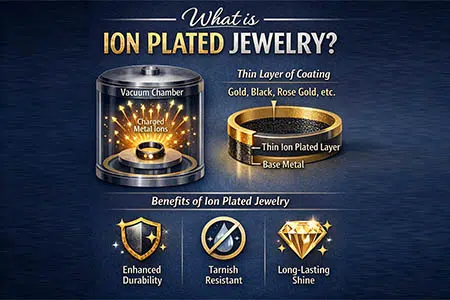
Ion plating is a kind of PVD (Physical Vapor Deposition). It is a group of coating processes, including the vaporization of solid coating material and condensation on the jewelry surface in a near-vacuum environment.
Ion plating forces the coating material to become part of the surface on the atomic level — there is a molecular bond, not just a layer resting on top.
The coating material applied is dependent on the color you want:
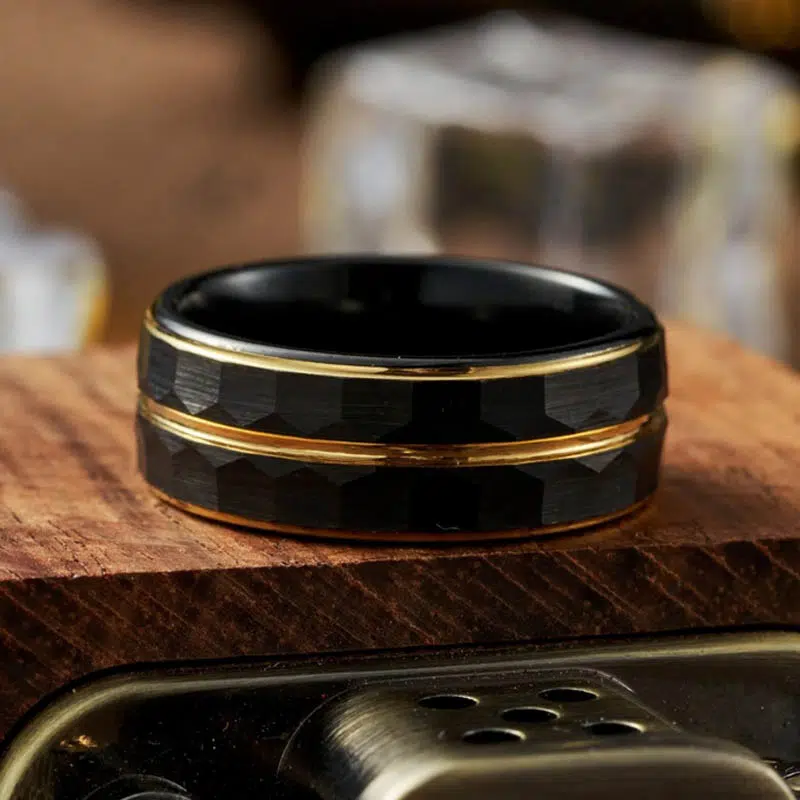
- Black ion-plated jewelry has titanium carbide
- Gold/yellow ion coating brings the addition of titanium nitride.
Both of these colors are incredibly tough, and this is one of the foremost reasons that clients buy ion-plated pieces that are scratch- and wear-resistant compared to ordinary plated options.
In case you are comparing it with other coating methods, take some time to read about e-coating for jewelry, which is a protective finish that can also be used.
Process of PVD Ion Plating
The ion plating process consists of four different stages, with the outcome of each stage building on the previous stage to create a tightly bonded coating to the stainless steel (SS) base.
Vacuum Deposition
The first stage involves a thorough cleaning process for all SS jewelry pieces that removes all oils, dust, and any surface contaminants from the jewelry pieces. Then the jewelry pieces are placed in a sealed vacuum chamber.
It is also very important that all the air is removed from this chamber because any minute-sized particles of either dust or gas will weaken the bond of the coating to the surface of the jewelry.
Sputter Deposition
Inside the vacuum chamber, the coating material (titanium carbide or titanium nitride) gets hit with high-energy ions. This bombardment causes particles of the coating material to eject from the source and travel through the vacuum.
Those particles then land on the stainless steel jewelry pieces, starting to build up the coating layer.
Arc Vapor Deposition
At this stage, the arc discharges on the coat element. It causes a highly ionized vapor metal plasma, that, in its essence, is a step ion gas.
This plasma is significantly more reactive than normal vapor and thus clings much more tightly to the steel, resulting in a denser and sturdier coating than regular sputter deposition.
Ion Plating (Final Bond)
The last step is a combination of vaporization and ionization. The metal vapor is drawn to the metal surface of the jewelry by electrical charge, and ions are driven into the surface of the stainless steel.
This is why ion-plated jewelry is different than any other “dipping.” Although it may look like it is simply “dipped” in there, it is actually fused with the steel.
For a one-on-one comparison of this process with standard electroplating, see PVD plating vs electroplating.
Advantages of Ion Plating on Jewelry
Superior Durability
Ion-plated jewelry is durable and resists daily wear, sweat, and scratches with a non-fading surface. The jewelry is ion-coated at a molecular level; thus, the coat will not peel off like in electroplated jewelry.
Jewelry brands get increased sales and happy customers. Want to learn how long IP plating lasts? Check out this blog.
Hypoallergenic Properties
Ion plating is very clean — it does not require chemical baths and has no nickel exposure.
Finished coatings are safe for sensitive skin and are hypoallergenic. Ion-plated stainless steel is a good alternative if your customers are prone to some type of skin reaction to normal plated metals.
Eco-Friendly
Traditional electroplating generates hazardous chemicals (like heavy metals and acids) during the plating process, which must be disposed of in an appropriate manner.
The PVD ion plating technique does not create any liquid chemical waste. As a result, it provides manufacturers with a more environmentally friendly method to manufacture their products.
Versatility
Ion plating can be used to add color or finish to jewelry, and the range available includes:
- The color of gold (titanium nitride)
- Rose gold
- Black (titanium carbide)
- Rainbow/multi-color
That makes it easy for a fashion jewelry company to create several color variations on the same design.
Low Maintenance & Water Resistant
Because the coating is fused to the underlying metal, items made by ion plating will provide greater protection against water and perspiration than electroplated jewelry.
Furthermore, since stainless steel has an inherent resistance to water, this property is substantially enhanced by using IP technology.
Therefore, customers are able to wear their jewelry when washing their hands or following light exercise.
Disadvantages of IP Plating
Cost
Ion plating is more costly than regular electroplating because it requires expensive vacuum equipment and also a more strictly controlled process.
Ion-plated jewelry is costlier than ordinary fashion jewelry, but it is still cheaper than made-up gold and gold-filled jewelry.
Resizing
If a customer requires their ring resized after purchase, cutting and reshaping the metal will damage the IP finish at the point where work is performed. The coating cannot just be reapplied to one area but must be completely replated for the entire piece to look uniform. Therefore, if you are selling IP rings, be sure to inform customers that they need to refer to the ring size chart before ordering their rings.
Not Indestructible
Although IP rings are very durable, they are still susceptible to scratching from certain things that are harder than the IP finish (such as diamonds, rough concrete, and other abrasive surfaces) over time. Even though the IP finish is much better than standard plating, customers should avoid wearing their IP jewelry while performing heavy manual labor and/or playing contact sports.
Ion Plating vs. Traditional Electroplating
Regular electroplating applies a coat to the metal surface – similar to painting a wall. Once the top layer has been worn down enough, it can chip or lift from the base. Ion plating bonds with the metal surface – this bond is at the molecular level, meaning the coating becomes part of the base material.
IP coatings are approximately 5-8x stronger than standard electroplated coatings.
Here’s a full comparison:
| Feature | Ion Plating (IP/PVD) | Traditional Electroplating |
| Process | Vacuum deposition + ionization | Chemical bath |
| Bonding | Molecular-level fusion | Surface adhesion only |
| Longevity | 2–5+ years | 6 months – 1 year |
| Scratch Resistance | High | Low to moderate |
| Cost | Higher | Lower |
| Hypoallergenic | Yes (nickel-free) | Often contains nickel |
| Environmental Impact | Low (no chemical waste) | High (toxic chemical waste) |
How Long Does Ion-Plated Jewelry Last?
Usually, an ion-plated piece of jewelry will stay good for 2 years or longer (up to 3-5 years) if properly cared for (i.e., how you would normally wear your jewelry). This is much longer than standard gold-plated items that have a much shorter lifespan. You can see how long gold plated jewelry lasts here.
Below are the factors that affect the lifespan:
- Wear frequency – The pieces that you wear every day will erode sooner than the jewelry that you wear once in a while.
- Chemical exposure – Perfume, chlorine (swimming pools), and the chemicals used for cleaning tend to bring about coating erosion.
- Storage – Keeping items in this manner reduces friction between them and other jewelry.
- Physical impact – Jewelry that is constantly hitting hard objects undergoes metal coating wear at a faster rate.
- Skin chemistry – Wearing down of jewelry may be marginally higher among people who have more acidic sweat.
Conclusion: Is It Worth the Investment?
For jewelry brands wishing to deliver an exclusive look at an attractive price, ion plating is without a doubt an excellent solution.
They last for years instead of just weeks, they are appropriate for sensitive skin, and the method creates much less waste compared to the traditional processes. Shoppers appreciate the better value offer, and brands experience fewer customer complaints about color fading or peeling.
If you’re looking to build a jewelry line using ion-plated stainless steel, OOTB Jewelry manufactures a full range of IP-finished pieces from our factory in Guangzhou, China. Contact us to request a catalogue or send your design for custom production.
FAQs
Is Gold Ion Plated Real Gold?
Gold ion-plated jewelry is real gold; it’s just a thin layer of plating. But its hardness makes it not easy to tarnish.
Is Ion Plated Jewelry Good?
Yes. Ion-plated jewelry can withstand scratches better than electroplated jewelry, making your jewelry last longer. This makes it perfect for everyday wear and, as such, is great for those fashion lines that need pieces with a longer life. It is a nice trade-off; it is not as costly as the precious metal jewelry, and at the same time, the quality is better than that of cheap jewelry.
Is Ion-Plated Stainless Steel Hypoallergenic?
Yes, ion-plated stainless steel is nickel-free, and it is safe for your skin and can be used even for individuals with sensitive skin or metal allergies.
It is the best option for those types of customers who cannot wear regular plated jewelry due to possible irritations.
 English
  French
  Spanish
  German
  Russian
  Turkish
  Portuguese