Introduction
It is easy to picture the type of earring you want (e.g., a small star on top with a small moon hanging down). However, you cannot draw it or describe it to a factory without getting stuck on the question: What is the name of the part that passes through the ear? And what is the name of the thing that keeps the dangling part in place?
Each earring consists of a combination of specific named elements. Having these elements named makes it easier to draw an earring and communicate with a China jewelry factory. In this blog, we will discuss parts of earring, including stud, hoop, and drop/dangling designs, and how these parts influence the design and manufacturing process.
What Are the Main Parts of an Earring?
An earring is not a single entity. Rather, it consists of several small elements that have different functions.
| Part | What It Is | Function | Common Types / Examples |
| Decorative element | The visible part that creates the main design | Gives the earring its appearance and character | Metal shape, gemstone, bead, charm, pendant |
| Post | A straight metal pin that passes through the piercing | Attaches the earring to the ear | Standard post, threaded/screw post |
| Earring back | A component placed behind the earlobe | Secures the earring post | Butterfly back, push back, screw back, silicone back |
| Ear wire / hook | A curved wire that passes through the piercing | Supports the earring | French hook, simple hook, ear wire |
| Hoop | The curved or circular body of the earring | Forms the main structure of a hoop earring | Round, oval, square, irregular |
| Jump ring | A small metal ring used to connect components | Joins parts together | Open jump ring, closed jump ring |
| Chain / connector | A flexible or fixed connecting component | Connects parts and can add movement or length | Jewelry chain, links, connector bars |
| Bail | A small connector that holds a pendant or decorative element | Allows a pendant to hang from another component | Pendant bail, pinch bail |
| Leverback | A hinged ear attachment with a closing mechanism | Provides attachment and security | Standard leverback |
Parts of a Stud Earring
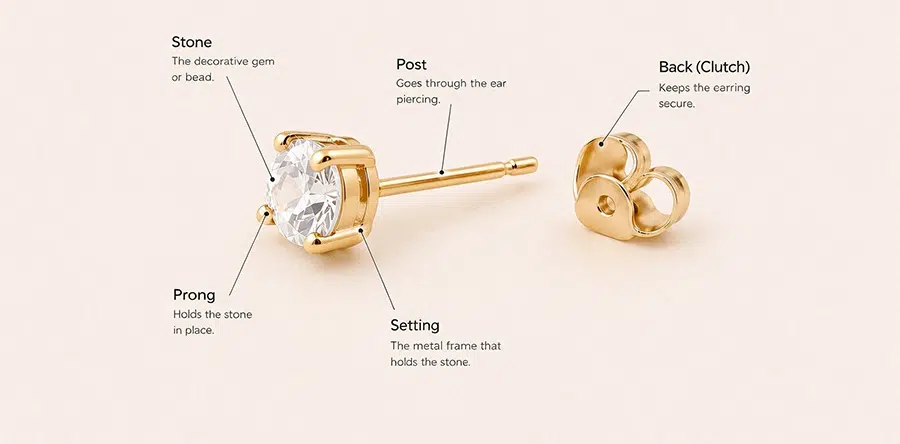
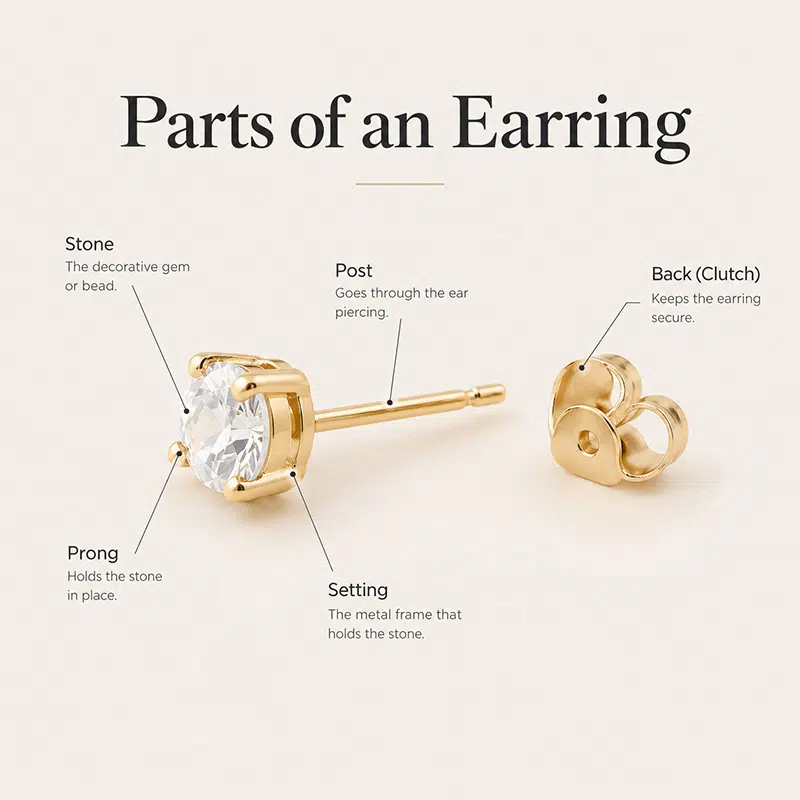
A stud earring is the easiest earring to manufacture and to learn about the elements of earrings. It sits flat against the earlobe and consists of three elements: a post, front decoration, and back.
Post
It is a metal pin that goes through the ear piercing. It resembles a nail and serves only one purpose – to secure the earring.
- Length – shorter when the stud is small and longer when the earlobe is thick.
- Thickness – thin post feels light and bends; thick post supports a heavy front.
- Position – at the center of balance of the front.
- Material – mostly made of stainless steel and sterling silver.
Decorative Front
Decorative front is the first thing that one sees and it may be a gemstone set in metal, solid metal shape, brand logo, bead, or enamel with colored fill.
A bigger and/or heavier front requires a strong post, which should be placed nearer to the center to maintain balance.
Earring Back
Earring back is what slips on the post to secure the earring so it does not fall off.
- Butterfly/push backs are easy to install but will tend to come loose
- Screw backs take longer time to put on but are more secure
Parts of a Hoop Earring
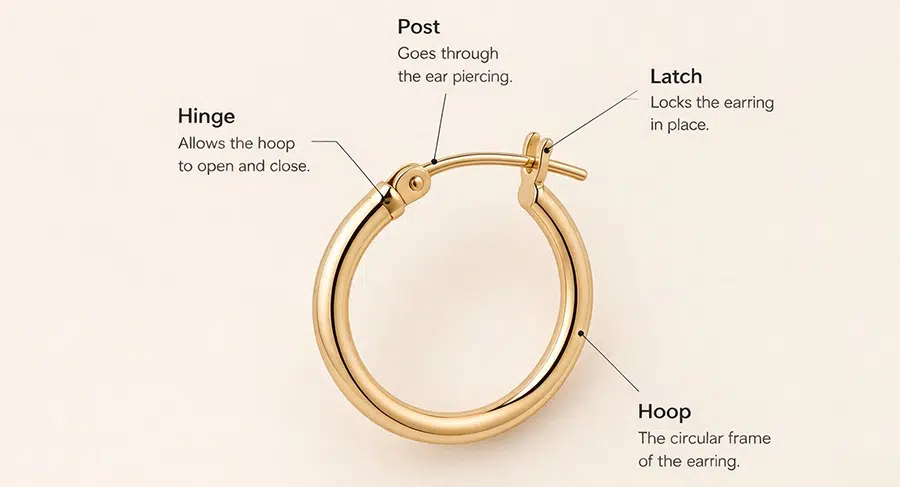
Hoop earring design is not like a stud; it is the body that is curved that forms the design instead of a front being attached to it.
Hoop Body
The hoop body is the ring-shaped piece that gives a hoop earring its name. It can be round, oval, square, or shapeless; thick or thin and smooth or not. A thick and large hoop will be statement-making and quite heavy to wear; however, a small and thin hoop will be lightweight and comfortable to wear on a regular basis.
Post or Ear Connection
A hoop still needs a way to attach to the ear. It can be a straight post in the piercing, curved wire, or a section of the hoop body that doubles as the connection point, depending on the size and weight of the hoop.
Hinge, Latch, or Closure
Typically, a hoop will have a hinge, latch, or clicker to close it. This needs to line up correctly every time, or the hoop sits crooked on the ear.
Parts of a Drop and Dangle Earring
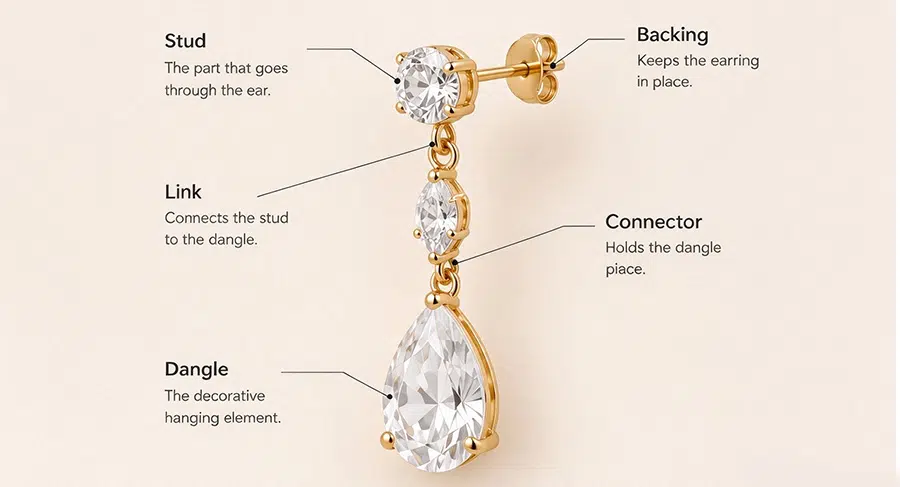
There are more components to drop and dangle earrings compared to stud or hoop earrings, because the decorative element hangs below where the earring attaches to the ear. A drop is quite close to the ear but allows limited movement, while the dangle is lower and swings freely; both definitions are usually interchangeable in practice.
- Fishhook – hangs from the ear and is easily attached, and allows for significant movement
- Post – a straight pin, used when a design should hang still
- Leverback – meaning a form of wire with a hinge and a lever, which is more secure than the fishhook.
A fishhook allows the most motion; a leverback holds the earring closest to the ear.
Connector
A connector is a small chain, link, or jump ring that connects the ear wire to the part hanging from it. It determines the amount of movement and length of the earring. A jump ring makes the earring shorter and simpler to wear; a chain makes it longer and sway.
Drop or Pendant
A drop or pendant is the decorative element hanging from the ear wire and is typically the first thing you notice. Weight, length, and shape of the pendant determine how it hangs and moves. A heavy pendant will move less and may deform the ear wire.
Bail
Bail is a small loop or a clasp that attaches the pendant to whatever it is hanging from, such as a chain or jump ring. Often, a bail is required for a flat pendant as it does not have a loop itself. Some earrings do not require a bail, as the pendant has a loop in the casting.
How Earring Parts Affect Jewelry Design
Weight and Balance
Depending on the weight of the decorative part, the earring may be pushed forward or tilted to the side uncomfortably despite an aesthetically pleasing design.
Size and Proportion
The scale of the post, connector, closure, and decorative part of the earring should be the same. A small stud requires a small post, while a large earring requires a larger post and a more robust connector. When choosing a small finding for a large earring, it is very likely to result in a bent earring, and it does not look good.
Material and Finish
Different parts of an earring can use different materials — a post often needs a harder metal than the decorative front. Common choices include stainless steel, sterling silver, brass, gold-plated metal, and PVD-coated metal, each with its own cost and durability.
Connection and Durability
Any joint of two parts of the earring is a potential place where it can break. Jump rings may open, soldered parts may break and hinges may deteriorate with time. Be careful with this when designing earrings.
How to Specify Earring Parts When Working With a Manufacturer
Provide the Overall Dimensions
Provide the final size in length, width and thickness. For dangle and drop earrings, provide the length from the top of the ear wire to the end of the pendant as the manufacturer will not be able to determine this from a sketch.
Specify the Materials
Indicate the material of the main body, and indicate the material again if it is different for any other functional part (post or closure). For example, you can specify sterling silver for the pendant and stainless steel for the post.
Specify the Earring Finding
Specify the type of finding you require: post, butterfly back, hook, leverback or hoop. If you have a sample or drawing of the finding, specify which part you would like.
Confirm the Connection Method
Indicate to the manufacturer how the parts should be connected to each other:
- Welded
- Soldered
- Hinged
- Screw
- Jump ring
Different connection types will have different strength, price and appearance when viewed closely. Depending on the type of component (CNC machined vs hand formed), different connection types may be used.
Confirm Finish and Color
Indicate the finish and color of the surface: polished, brushed, sandblasted, gold PVD color or plated. Finish determines the way light is reflected from the component, the longevity of the color, and the unit price.
Final Thoughts
A custom earring does not need to rely on standard, off-the-shelf components. Once a designer defines the main parts, the dimensions, the materials, and how each piece connects, a manufacturer can review the construction and work out how to turn the design into a production-ready sample.
OOTB builds custom earrings in its own factory in Guangzhou, China. With more than ten years of export experience, our team can take a rough sketch or a full spec sheet and turn it into a finished sample. Visit our custom jewelry design page to start a project, or contact us with your earring specs.
 English
  French
  Spanish
  German
  Russian
  Turkish
  Portuguese