

Introduction
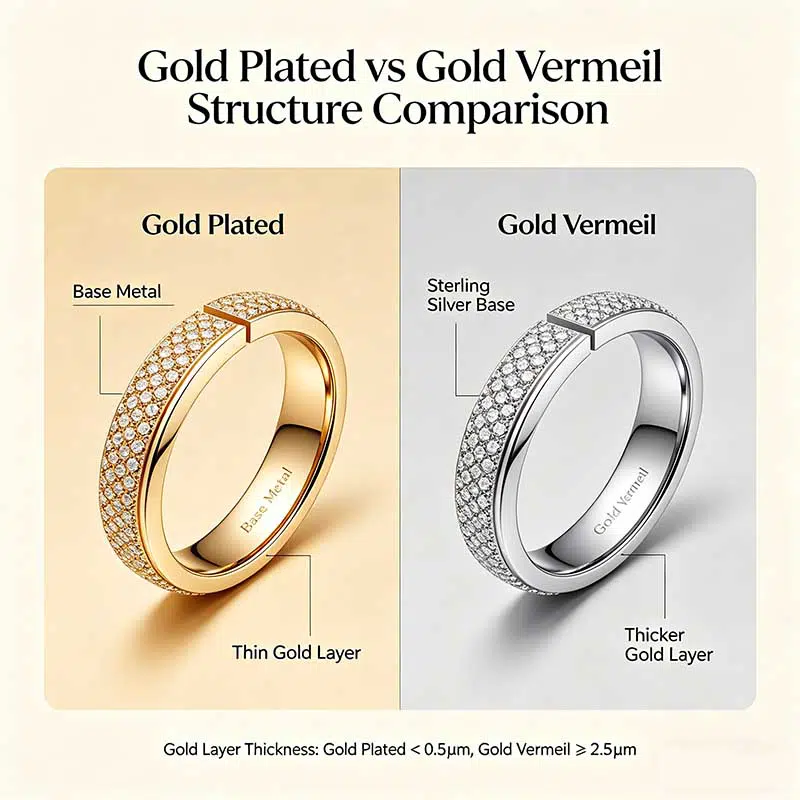
Customers nowadays look for something superior to what fast-fashion jewelry provides. While they are not wholly willing to spend their money on a solid gold piece. This is where gold vermeil, gold plated, and also filled gold jewelry have become popular.
Choosing the wrong finish for jewelry companies is simply mismatched pricing and having returns.
This article explains Gold Plated vs Gold Vermeil, including meaning, technicalities, and the ROI of credibility. You will choose the best fit for your jewelry brand after reading this.
Understanding Gold Vermeil
The Legal Requirements & Definition
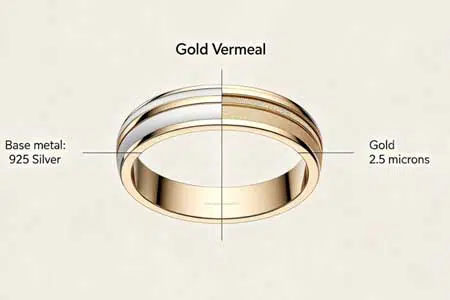
Gold vermeil has a legal definition rather than being used to promote a product. To be considered vermeil, a piece must fulfill three criteria:
| Requirement | Minimum Standard |
| Base metal | 925 sterling silver |
| Gold purity | 10K (41.7% gold) |
| Gold thickness | 2.5 microns |
If any one of these criteria is not met, that piece is not legally considered vermeil; it is only considered as gold-plated.
A key detail is that the base metal has to be marked “925.” The 925 mark indicates that, prior to having gold added, the piece is made from a precious metal; refer to this article to find out what stamps in jewelry signify concerning the sourcing of jewelry.
Understanding Gold Plated & Gold Filled
Standard Gold Plating (Electroplating)
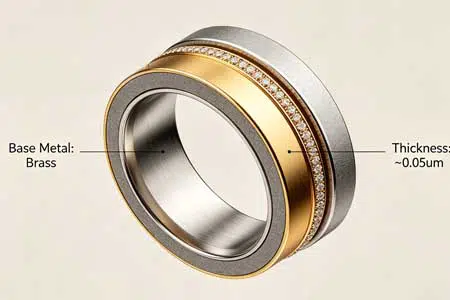
Standard gold plating is done using electroplating, which involves applying a gold coating over a relatively inexpensive base metal, usually brass or copper, with the use of an electric current. In normal conditions, a thickness of 0.05 microns is deposited over the base, which is five times thinner than the thickness of the vermeil.
- Base metal: Brass or copper in most cases
- Layer of gold: At least half a micron thickness with a flashing effect.
- Cost: The lowest entry point for gold-tone jewelry
- Durability: Limited — gold plated jewelry can show wear within months under daily use
For stainless steel-based jewelry, it will be different. Many jewelry casting manufacturers are applying PVD coating to stainless steel. The PVD adhesion is molecular, and it offers a waterproof guarantee that the electroplating cannot.
If your company offers water-resistant or active lifestyle jewelry, it is recommended that you consider choosing between PVD plating and electroplating prior to the sourcing decision.
Gold Filled: The Durability Heavyweight
Many people mistakenly think that gold-filled jewelry is the same as gold-plated jewelry; however, these two products are made in very different ways.
Gold-filled jewelry is made by bonding a layer of gold to a base of brass using heat and pressure rather than the process of electroplating.
Gold-filled jewelry must contain at least 5% gold of the total weight of the item.
The amount of gold in gold-filled jewelry is greater than that in either standard gold-plated or vermeil jewelry.
Due to the mechanical bond formed between the two metals and the percentage of gold in the item, gold-filled jewelry will hold up better to wear and tear from everyday use compared with other types of jewelry.
Check out our guide for more information about what gold-filled jewelry means before you list it for sale.
Technical Comparison: Vermeil vs. Plated
The 2.5 Micron “Barrier” vs. Tarnishing
When you notice tarnish on gold-tone jewelry, it’s inevitably the base metal you’ve observed reacting with oxygen, as the gold is worn away enough to expose it.
| Finish | Gold Thickness | Barrier Quality | Tarnish Timeline |
| Standard gold plated | ~0.05 microns | Porous, gaps in coverage | Weeks to 6-8 months |
| Gold vermeil | 2.5+ microns | Dense, full coverage | 1-5 Years with proper care |
| Gold filled | Varies, 5% by weight | Thick mechanical bond | 10-30 Years |
Base Metal Integrity & Skin Sensitivity
The impact of the base metal selection on customer wearability.
Brass-stained fingers concern: Brass will oxidize when there is exposure to skin, sweat, and air, and that oxidation will transfer onto the skin as a green stain. This is safe for the wearer but causes a fast loss of confidence in the producer for the consumer.
If you are providing plated brass products, then customers who are more active or in warm climates would notice their problems quickly. See more about preventing copper stains on the skin if your line includes copper products.
Vermeil (gold-plated silver) is considered to be hypoallergenic because it has a base of 925 silver and a thicker gold coating. Thus, it will not stain the skin or create any adverse reactions to the wearer from a metal allergy. For brands looking to create a nickel-free jewelry collection, vermeil will be the cleanest option structurally.
Performance in the Real World
Different finishes serve different brand strategies. Here’s how each one plays out from a business standpoint:
| Finish | Best For | Trade-Off |
| Gold Vermeil | Luxury branding, gift jewelry, 925-stamped collections | Requires care instructions; friction wears gold layer, typically last 2 years |
| Gold-Plated | Fashion Jewelry branding | No precious metal content; it can wear off within 6-8 months |
Conclusion
Gold vermeil represents the best option for brands looking to develop a luxury or demi-fine collection of jewelry because it is composed of two precious metals, has a 925 stamp, and does not contain any industrial base.
Gold PVD Stainless Steel is best for brands that create items for daily wear, where there is constant friction on their pieces
The final choice will depend on your customers and price point. To discuss sourcing options for your brand with OOTB, please contact us to identify the right construction for your brand’s needs.
Frequently Asked Questions (FAQs)
Does Gold Vermeil Tarnish?
Yes, but it happens only if the gold coating wears off.
A gold thickness of 2.5 microns protects the 925 silver completely from air and moisture in normal conditions. If preserved well with no chemicals and airtight storage, a vermeil product can last for years. If scratched or rubbed, the object tarnishes as the gold layer gives way to the silver.
Is Vermeil Better Than Gold Filled?
It depends on what “better” means for your use case. Vermeil has higher intrinsic value because both the base and the surface are precious metals. Gold filled has better physical durability because the gold is mechanically bonded at a much greater thickness. Luxury positioning? Vermeil wins. Daily-wear longevity? Gold filled wins.
Can I Shower in Vermeil?
Periodic exposure to water is not a problem and not a deal-breaker. What ruins it is that when you shower daily, the gold is exposed to daily soap, towel friction, and steam. It will eventually wear the gold down until the silver core is exposed. For jewelry that is exposed to water daily, PVD-coated stainless steel jewelry is considered to be a more viable alternative.

 English
  French
  Spanish
  German
  Russian
  Turkish
  Portuguese