Introduction
Your choice of manufacturer will determine everything – quality of your products, your margins and your speed to market. A good partner will help you to grow seamlessly; a bad one will cost you in time, resources and credibility.
This five-step guide shows you how to find a jewelry manufacturer, vet, and secure a manufacturing partner that will be a good fit for your brand.
Step 1: Define Your Product and Production Requirements
Clear About Your Business Model
Be clear about what you’re looking to produce before sourcing different factories and manufacturers. Factories have their specialties. The tighter your requirements, the better the match.
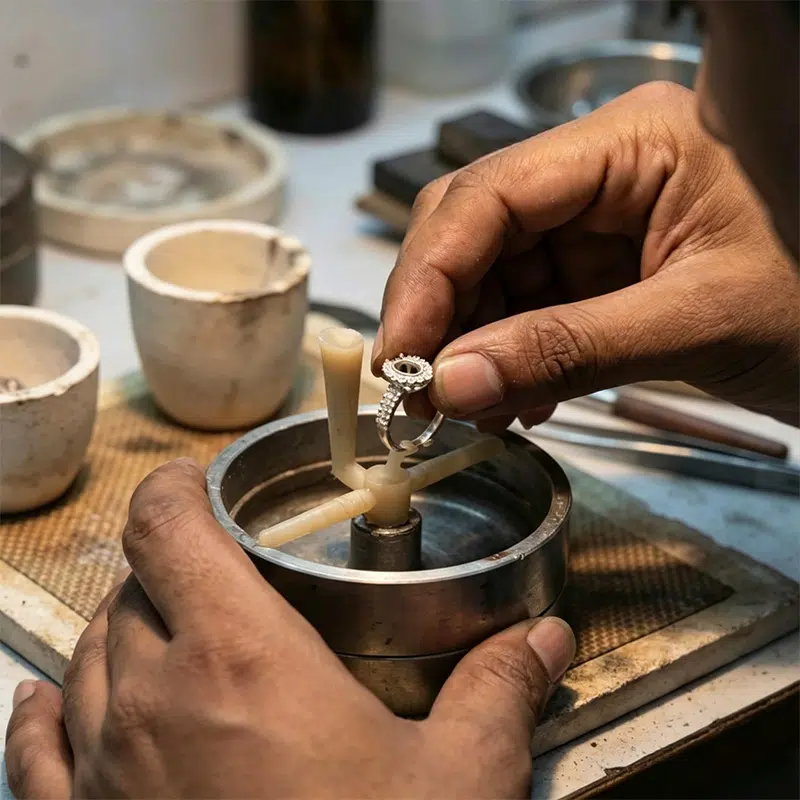
OEM (Original Equipment Manufacturing) means that you come up with the design (CAD files, technical packs, etc.) and the factory produces it exactly like you intended. You maintain complete creative freedom, but the MOQ will be higher because it needs to start from scratch. A dedicated OEM jewelry manufacturer handles everything from mold-making to final polishing.
ODM (Original Design Manufacturer) means that you get to pick from the existing designs of the manufacturer and add your names or branding info. It’s a good idea for start-up brands, as ODM requires less MOQ, since molds already exist.
| Model | Who Designs | Typical MOQ | Best For |
| OEM | You (the brand) | Higher (50–200+ pcs) | Established brands with custom designs |
| ODM | Factory | Lower (10–50 pcs) | New brands testing the market |
Specify Material and Technical Parameters
Be clear about what kind of base material you would like to use for your jewelry.
Some factories produce 925 sterling silver jewelry, others 316L stainless steel, some brass, and some leather and stone.
Choose the factory that is good at meeting your demands.
Establish Your Operational Constraints
Before having any conversation with factories, be sure to determine these three numbers:
1. Minimum quantity order by style – What quantity can support each style?
2. Cost of goods sold – What costs can be landed to maintain the margin?
3. Time of delivery – How many weeks will the order take?
If factories cannot meet all three points or terms, they will be useless for you. For example, low MOQ jewelry manufacturer may be useful for you to launch a few designs with relatively low quantities.
Step 2: Where to Find Verified Jewelry Factories
Finding out how to locate real jewelry manufacturer options might require a bit of research. Below are the approaches which work.
Online Sourcing Hubs
The simplest means of finding suppliers are through popular B2B websites such as Alibaba, Global Sources and Made-in-China. It is advisable to filter suppliers based on their “Verified Supplier” and “Trade Assurance” status. Additionally, check for buyer reviews and avoid those suppliers that don’t have transaction history.
Industry Trade Shows
Face-to-face meetings are better than hundreds of emails. Some of the trade fairs are:
| Show | Location | Focus |
| Jewellery & Gem ASIA Hong Kong (JGA) | HKCEC, Hong Kong | Asia’s No.1 mid-year B2B jewellery buying destination. Features two co-located fairs with over 1,100 exhibitors, ideal for sourcing ready-to-ship and seasonal inventory. |
| JCK Las Vegas | The Venetian Expo, Las Vegas, USA | The most important B2B trade show for the jewelry industry in North America. A global gathering for thousands of qualified professionals for product sourcing and networking |
| IJS Istanbul Jewelry Show | Istanbul Expo Center, Turkey | A leading, well-established exhibition since 1986. A strategic hub connecting Europe, Asia, Africa, and the Middle East, with 80% of Turkey’s international jewelry sales happening here. |
| Bangkok Gems and Jewelry Fair | QSNCC, Bangkok, Thailand | A key B2B fair in a major colored gemstone and jewelry manufacturing hub. Brings together jewelry buyers and suppliers in one of the world’s most important ruby and sapphire trading centers |
| The Jewellery Show | Olympia, London, UK | The largest B2B fine jewellery event in the UK. It attracts over 3,500 jewelry professionals and is a key event for retailers of high-end jewelry and watches to meet new and established suppliers |
| Vicenzaoro | Vicenza Expo Centre, Italy | A true international hub for the entire goldsmith and jewelry supply chain. It showcases everything from high-end jewelry and precious stones to packaging, technology, and manufacturing solutions |
At a show, you get to touch the jewelry and ask technical questions to suppliers. Many businesses start their long-lasting partnerships at these events where they meet suppliers. Your strategy will be refined and sharpened based on the information that you get from your competitors online.
Search Engines
Google does the job that does the trick, provided you use the right terminology.
Use “jewelry manufacturer,” “sterling silver factory,”, “custom jewelry supplier.”, etc. as search terms and phrases. If you want to learn how to find wholesale jewelry suppliers in a specific region, add the location to your query.
Social Media and Forums
Instagram and Facebook have many communities of jewelry makers. Search hashtags like #jewelrymanufacturer or #jewelryfactory. Join Facebook sourcing groups and see the reviews that members provide about the suppliers.
Reddit has an r/jewelries community where users tell real experiences with suppliers – both good and bad. These communities can notify you about factories with quality problems before you have to pay for them.
Ask AI
Nowadays, manufacturers may be recommended via AI tools such as ChatGPT or Claude. The secret lies in formulating the prompt in detail.
Rather than “find me a jewelry factory,” one should say “I need a manufacturer of stainless steel necklaces that accepts a 70-piece minimum order quantity and provides PVD gold plating”. The more detailed the description, the more relevant the recommendations will be.
Step 3: Vetting and Screening Potential Manufacturers
You have a shortlist. Now tell the factories apart from the middlemen.
Trading Company vs. True Factory
You have a shortlist. Now tell the factories apart from the middlemen.
A trading company buys from factories and sells products to you. A real factory produces products in-house.
Ask for a business license (factories should have “manufacturing” as a business scope), a video of the production floor, and pictures of equipment like casting machines in-house. Ask a technical question regarding production. If third-party companies “check with the team,”, then you are probably dealing with a trading company.
Key Questions to Send Before Ordering Samples
| Questions | What to Look For |
| What are your standard MOQs for custom vs. stock designs? | Stock items: 10–50 pcs; custom: 50–200+ pcs |
| What quality testing reports do you provide? | REACH compliance, nickel-free certs, lead-free test results |
| What is your defect rate and replacement policy? | Under 3%; clear rework or refund terms for defective pieces |
Evaluating Technical and Production Capabilities
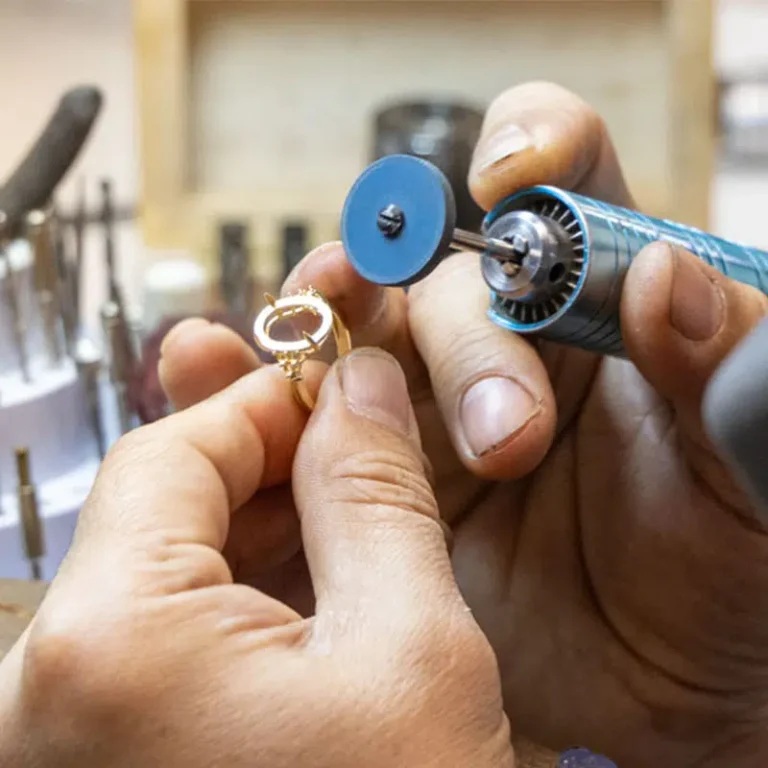
A capable factory manages everything under a single roof. Inquire about the factory’s in-house CAD design, rapid prototyping, lost wax casting, and PVD vacuum plating facilities. If the company outsources three or more of the stages from this set, controlling quality at all levels becomes very difficult.
Step 4: The Sampling Process (From Tech Pack to Physical Product)
Samples are your proof. Never skip this stage.
Preparing a Complete Tech Pack
A tech pack is your design blueprint. Your tech pack should include 3D sketches with exact dimensions in millimeters, metal quality (for example, 316L or S925), type of coating and thickness, expressed in microns, and tolerance range (±0.1–0.3 mm). The more precise your tech pack, the fewer surprises you will get when your samples arrive.
The manufacturer that provides custom jewelry design services must have a look at your tech pack in order to find any possible problems in production before making molds.
Ordering Initial Samples
Shipping time is also very important. A manufacturer that provides samples in 10–14 days will be able to handle production in the same way. A manufacturer that takes four weeks to prepare samples will not become more efficient in bulk production.
Inspecting and Testing the Sample
Run these checks when the sample arrives:
- Dimensions — Use calipers; match against tech pack specs
- Weight — Within tolerance of the specified gram weight?
- Clasps and closures — Open and close 50 times; do they stay secure?
- Wear test — Wear the piece for a week; does plating rub off or scratch easily?
- Finish — Check polishing quality under good light; look for rough edges or uneven surfaces
Step 5: Negotiating Terms and Protecting Your IP
Protecting Your Intellectual Property
Make sure that you sign a non-disclosure agreement (NDA) before transferring your CAD files or original drawings. Trustworthy manufacturers are quick to sign the NDA, while those trying to avoid it should be avoided.
At the same time, an NDA must be comprehensive and ensure the ownership of the drawings and molds. It is better to work with a private label jewelry manufacturer with a satisfactory track record of protecting clients’ intellectual property rights than with an unknown supplier that offers the lowest price.
Understanding Payment Terms
Standard industry terms: 30% deposit to start production, 70% before shipment. For a first order with a new factory, use Trade Assurance (Alibaba) or an escrow service—these hold payment until goods pass inspection. Wire transfers work once you have built trust over multiple orders.
Establishing a Quality Control (QC) Agreement
It is necessary to establish and agree on Acceptable Quality Limit (AQL) before the start of production. For instance, AQL 2.5 is typically used in the production of fashion jewelry – this means that the batch of 200 units can have up to 10 defective ones. Make sure that the right to third-party inspection or video inspection is guaranteed prior to paying the final amount. Remove from your list a provider that does not accept inspection prior to receiving full cash payments.
Conclusion
Now, you’re clear about how to find a jewelry manufacturer, they key is not the lowest price, but you’re going to find a partner who can communicate more easily, provide you with good quality, and follow and support your idea.
The solutions are 5 steps: define your needs, use multiple channels to search, vet thoroughly, ask for samples, sign NDA protect you.
At OOTB Jewelry, we have spent a decade supplying brands from our factory in China—with different ready-to-order styles and full OEM/ODM support. Ready to start your next collection? Send us an inquiry, and we will walk you through the process.
 English
  French
  Spanish
  German
  Russian
  Turkish
  Portuguese