

Introduction
When a client chooses a piece of jewelry, they evaluate it within approximately three seconds. The heaviness, the sensation on the skin, and especially the shine, are the factors involved in the process.
It is important to note that the shine is not produced by the base metal, but rather as a result of jewelry polishing. Polishing is one of those aspects of jewelry-making that gets too little attention, even though it influences both the appearance and longevity of jewelry.
The guide highlights the concept of polishing and the reasons it is important in the jewelry industry, what impact polishing has on plating processes, types of finishes available, and what questions to ask before choosing a manufacturer.
Key Takeaways
- Polishing is the final mechanical step that removes micro-scratches, pits, and casting marks before jewelry gets plated or shipped.
- Good polishing raises perceived value, cuts customer complaints, and slashes return rates for bulk buyers.
- Plating quality starts with surface smoothness — rough metal beneath plating causes peeling, uneven color, and visible bumps.
- Five surface finishes suit different brand positions: mirror, matte, satin, brushed, and sandblasted.
- Checking a manufacturer’s polishing process before ordering can prevent expensive quality failures.
What Is Jewelry Polishing?
Polishing jewelry is a type of mechanical finishing process.
After casting, raw jewelry pieces come out with sprue marks, slight roughness, and surface pores.
Workers remove from the surface unevenness, scratches, and pits that may result from the lost wax casting and stamping processes using rotary wheels, compounds, and very fine cuttings, and then the jewelry can proceed to different treatments such as rhodium plating, gold plating, or a final polish.
Why High-Quality Polishing Matters for Business
Higher Perceived Value
Buyers tend to associate a mirror-like surface with luxury. If a necklace or a ring can slide on the skin without any drag and has a uniformly reflective surface, then they know that it is an expensive piece.
They are willing to invest in fine jewelry that has an expensive look and feel. Polishing will give you the power to be able to sell a casting at a luxury price point as opposed to the mainstream price point.
We’ve seen identical designs of rings sold at two distinct prices, with polish grade being the only difference. Just the polishing quality can increase the price by 50 to 60 percent.
Fewer Customer Complaints
Poor polishing creates micro-scratches which retain dirt and body oils and make your jewelry look cloudy after only a week of wearing. Tiny inconveniences cause immense problems for the final customers. If your supplier does it right, this inconvenience will never reach your email box.
Fewer Returns
Returns are a shrink to the jewelry brand. A run of jewelry that comes shiny, bright, and uniform doesn’t get returned. If you’ve polished to a high standard, customers see that quality as soon as they open the box, and there’s no question: They’ll keep the order. That’s creating customer loyalty.
Why Polishing Directly Affects Plating Quality
Good Color Starts with a Smooth Surface
Gold plating, rose gold, and rhodium coatings are applied in the form of very thin layers, normally at a range of 0.3 to 2 microns, depending on the jewelry material.
If the base metal has scratches, the plated layer simply fills in those grooves and follows the outline of the scratches. While a smooth polish leaves a coating of the plating that is even and uniform with color from border to border.
The “Pimple” Effect
A micron-thick color layer covering a scratch, blemish, or dent is not able to make the defect disappear. In fact, a layer makes it worse.
Light can hit the uneven spot; the small scratch you had on the bare metal now becomes a pronounced bump on the coated part. For jewelry manufacturers, it is the “pimple” effect. The solution for this problem is not a thicker layer of paint, but rather to improve the polishing.
Preventing Peeling and Fading
Plating attaches through a chemical bond or physical connection to the surface of the metal. A surface that is dirty, rough, or uneven provides fewer points of contact between the coating and the surface. As time goes by, the plating starts to become undone, chip off, or rub off in spots.
A quality polished surface provides the coating with the strongest and longest holding power, which improves jewelry lifespan.
Common Jewelry Surface Finishes and Comparison
Different surface finishing produces diverse looks in jewelry. Each of them is best suited for a particular position on the market, and each brand’s identity.
In the chart, you can see the five most popular types of surface finishing used in jewelry production.
| Finish Type | Appearance | Brand Positioning | Key Feature | Relative Manufacturing Cost |
| Mirror | High-gloss, reflective | Luxury, bridal, fine jewelry | Maximum light reflection | Higher (more steps) |
| Matte | Flat, non-reflective | Modern, men’s jewelry, minimalist | Soft look, hides minor wear | Medium |
| Satin | Soft sheen, slight glow | Premium, professional, unisex | Elegant without high shine | Medium-High |
| Brushed | Directional fine lines | Contemporary, minimalist, industrial | Textured, hides scratches well | Medium |
| Sandblasted | Grainy, frosted texture | Fashion, edgy, streetwear | Unique tactile feel | Lower (after equipment setup) |
Mirror Finish
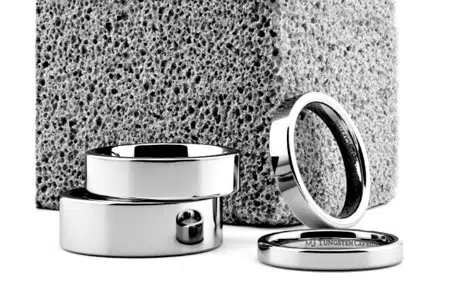
Mirror polishing provides jewelry with the highest reflection. The metal surface becomes so smooth that it acts like a mirror, reflecting light and surroundings with near-perfect clarity.
Mirror polish finish sets standards for luxury, wedding, and luxury stainless steel jewelry. You need to pass through a few stages of finer polishing compounds for a mirror finish. The mirror finish is worth the pain: You can make a big profit with a mirror-finish piece.
Matte Finish
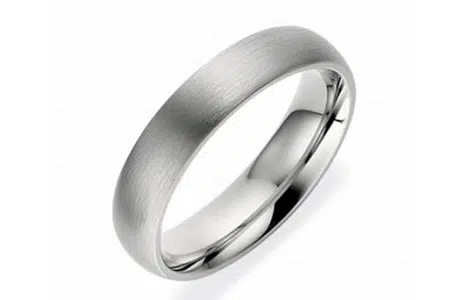
A matte finish absorbs and scatters light rather than reflecting it. Surface unusually flat, so a matte flat surface looks soft and modern. Matte surface finishing is commonly used on men’s jewelry and minimalist collections due to its contemporary and understated design. Matte surfaces also disguise scratches and fingerprints better than mirror sheen, which can be useful for jewelry worn all day.
Satin Finish
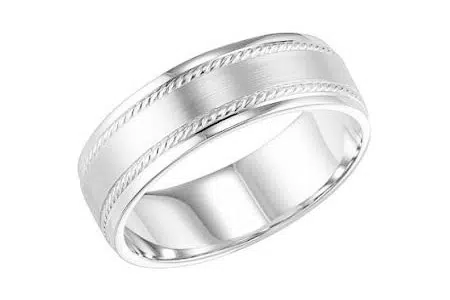
Satin is in between the mirror and matte directions; it is a gentle sheen, similar to light falling on silk. Unlike a mirror polish, it is not fully reflective.
You will often find satin on luxurious watches, wedding bands, and a few reputable jewelry brands. The finishing has a minimalist look, and yet it doesn’t look noisy; therefore, it is suitable for concepts defined for young professionals who want something chic, but not ostentatious.
Brushed Finish
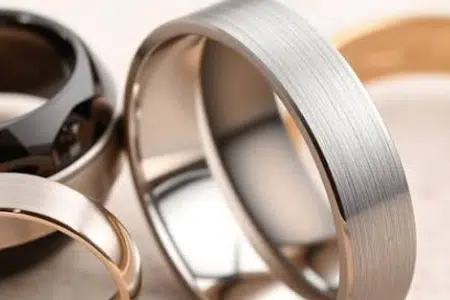
Brushed finishing employs abrasive pads or wheels, which move in one direction in order to create fine, parallel lines crossing the metal surface. So, it hides surface scratches incredibly well, as the new scratches fall into the existing pattern.
This kind of jewelry is popular among minimalist and industrial-style brands.
Sandblasted Finish
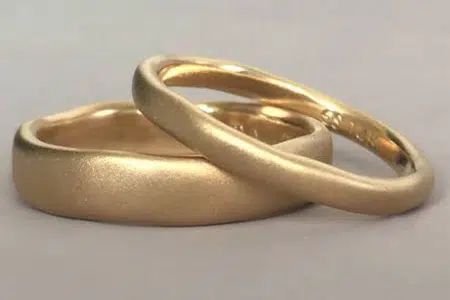
Sandblasting shoots fine particles of grit at high velocity against the surface of the jewelry, creating a uniform frosted look.
The appearance of sandblasting is grainy and matte-like. Sandblasting is mainly seen on fashion-forward jewelry, urban clothing brands, and avant-garde pieces.
What Determines Jewelry Polishing Quality?
Good polishing is not caused by one activity or tool. It is the result of several different elements.
- Base material — Different metals respond differently to polishing. Sterling silver grinds and polishes more easily than many grades of stainless steel, which is harder and requires mandatory compounds.
- Skilled hands — Polishing still remains a task that requires the talent and skill of a professional who can sense the quality of the surface and spot the defects through their appearance.
- Right equipment — Professional polishing motors, dust exhaust systems, and ultrasonic cleaners all contribute to the result.
- Surface preparation — The casting or stamping quality going into polishing determines how much work polishing needs to do.
- Quality control checkpoints — Experienced manufacturers will check surfaces at various points in the process and not solely after production.
Professional Jewelry Polishing Process
There are seven stages in the professional polishing process. It is important not to skip one: if one step is lost, the final result will lose its luster.
- Casting gives the basic form to the metal from a jewelry mold.
- Grinding eliminates sprue marks, parting lines, and other coarse surface textures with the aid of coarse wheels or belts.
- Pre-polishing runs with medium-grade compounds to get a flat surface and remove grind marks.
- Final polishing switches to fine grit in order to achieve the required texture: mirror, satin, or matte.
- Ultrasonic cleaning shakes off all polishing debris and metal powder so that there are no contaminants in the plating line operations.
- Plating only colors once the surface is completely polished and clean.
- Final QC inspects all items in proper lighting prior to packing.
Questions to Ask Your Jewelry Manufacturer About Polishing
Before you proceed with the bulk purchase, ask your supplier the five questions. Their answer will tell you the quality of their products.
- What polishing steps do you use for my product type?
A specific, detailed response indicates an actual process. Non-descriptive answers are a warning sign.
- Do you check surface quality before plating?
They should answer yes, and tell you in detail what they are inspecting for, namely: scratches, pits, rough patches, et cetera.
- How do you prevent scratches during batch production?
A good supplier will use separable trays, dividers, or cloths. Rather than throw parts into a bin.
- What QC happens before the order ships?
Look for a multi-point check: surface finish, plating adhesion, clasp function, and visual inspection under proper lighting.
- Can you match the same finish across a full production run?
Experienced suppliers maintain physical samples as references for each subsequent order.
Frequently Asked Questions
Can polishing remove scratches?
Yes, polishing can smooth over surface scratches and light scratches from the surrounding surface material.
Deep scratches and dents may require filling in or re-soldering, or even re-casting if it’s too bad.
Which surface finish is best for luxury jewelry?
Mirror finish is the standard for luxury and wedding jewelry. Its reflective surface enhances stone sparkle and denotes class. Satin finish comes in second for brands wanting an elegant, contemporary aesthetic without a high polish.
Conclusion
Jewelry polishing is never just a cosmetic extra. It is one of the key determinants of the quality of the jewelry, which will affect the appearance, touch, and durability.
And, every plating decision, every surface finish choice, and every customer’s first impression traces back to the polishing stage.
When you choose a manufacturing partner, look at their polishing capability the same way you look at your design catalog and material options. Polishing should be considered the core skill for the manufacturer.
At OOTB Jewelry, we polish all jewelry under the skillful eyes in our workshop in China, using a controlled procedure and batch-level final QC.
If you are looking for OEM or ODM jewelry manufacturing service with a consistent and high-quality surface finish effect, please contact our team and let’s talk about your project.
 English
  French
  Spanish
  German
  Russian
  Turkish
  Portuguese