
Introduction
Many jewelry businesses face the same issue. They order too much, and their cash remains tied up in inventory boxes. Or they order too little, and a best-selling item runs out of stock. Both situations harm the business.
Jewelry inventory management is more complicated to handle than most products. One jewelry design might hold many variations of size, color, metal, and type of finish. Every variation is a different product.
The blog explains to small jewelry brands and online vendors how to keep track of inventory and vendors, and get insights into what sells and what to reorder. If you are starting a jewelry business, these habits will save you from the most common mistakes.
What Is Jewelry Inventory Management?
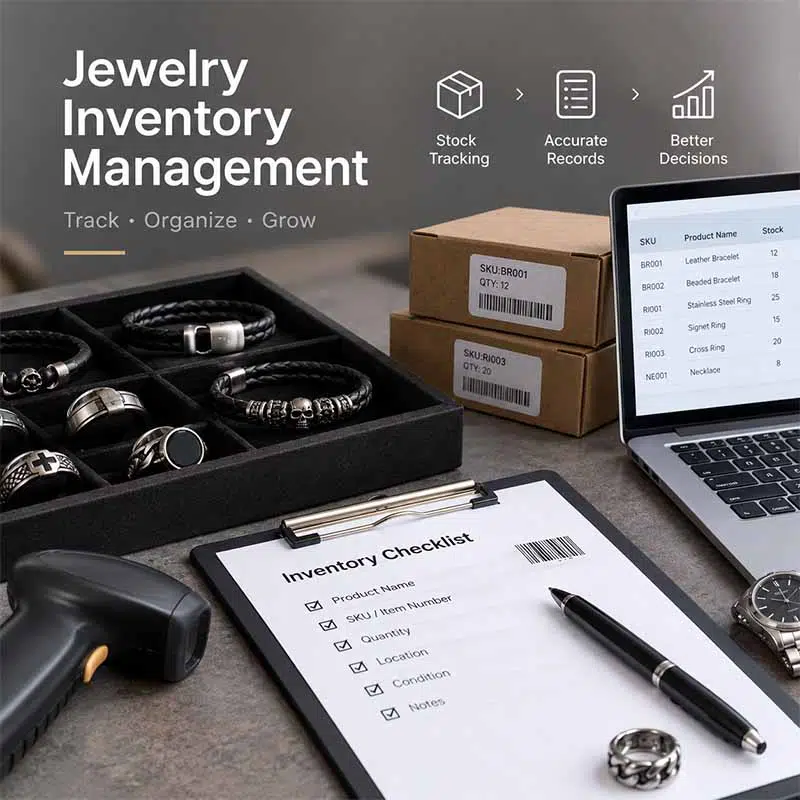
Jewelry inventory management means two things. First, you know precisely what you have for sale. Second, you use what you sell data to decide what to stock, order more of, decrease, or eliminate.
The inventory tracking lets you know what items are available in your stock.
Inventory management tells you what to do next based on the sales data.
You will make a purchase based on the analysis. It all comes down to four actions:
1. Track every product and its stock count.
2. Analyze which products sell fast and which do not.
3. Reorder the goods that sell.
4. Review the results and adjust.
How to Track and Organize Your Jewelry Inventory
Create a SKU for Every Product and Variation
Each variation of a product requires an individual code known as a SKU. SKU refers to a short code naming a very specific product.
Two stainless steel rings with different sizes of 6 and 9 are two different products. A style in gold and rose gold colors is also two products.
Below are the basic information you can use for SKU:
- Types of Jewelry
- Material
- Dimensions
- Color
Here is a simple example:
R-316L-BLK-08
This SKU states that it is a ring, 316L stainless steel, black, size 8. A clear SKU easily indicates what is selling and what needs to be reordered.
Track Your Stock Levels
Once you have your SKUs, monitor the quantity of stock you have for each one. These five numbers are important:
- Current stock – what you have.
- Available stock – what you can sell.
- Reserved stock – stock that is promised to customers or is reserved for photo shoots;
- Incoming stock – stock you’ve ordered from your factory, but it hasn’t arrived yet;
- Damaged or returned stock– stock that is damaged or returned pieces.
You might think you have 100 rings in your jewelry stock. But 20 are reserved for wholesale clients, 10 are damaged, and 30 are incoming from the factory. That means you only have 40 that are available for sale. Monitor these five numbers of your fast-selling pieces. That way, you won’t be overselling pieces you can’t deliver to your customers and missing a stockout because you counted reserved pieces as available stock.
Record Supplier and Purchasing Information
Management of inventory should not only focus on items but also record purchase data from your supplier.
For example:
- Manufacturer Name
- Cost per unit
- Minimum order quantity
- Lead time for production
- Delivery time
- Date of previous purchase
This information can connect your inventory with your procurement activities. It lets you know that the price of a product is $4 per unit, with a delivery time of 25 days, to plan your order easily.
Track Sales by Product and Variation
Monthly sales volume is not sufficient. A brand may sell 100 rings in a month; it sounds great.
However, it happen: 100 rings come in different ring sizes. Ring size 8 may have sold 70 pieces, while the others have sold 30 pieces.
But you have to monitor sales at the SKU level. It will allow you to understand which products bring money and which ones do not sell at all. This can help you make decisions about what to order and what to cancel.
How to Identify Fast-Moving and Slow-Moving Jewelry
Once you have tracked the inventory, it is time to determine the meaning behind the data.
Here are four criteria you can analyze:
- Sales velocity – how quickly a product sells.
- Sell-through – the share of bought stock that has sold.
- Inventory turnover rate – how many times your stock sells and is replaced each year.
- Aging inventory – inventory that has been sitting unsold for a long time.
Keep all of this simple. The goal of this effort is to determine which product needs replenishing and which ties up cash.
Fast-Moving Jewelry
Fast-moving products are your quickest sellers, and they’re your best sellers. Keep a close eye on them because a stockout means lost sales.
If a customer wants your best-selling necklace and it’s out of stock, they will buy elsewhere. So, best sellers justify higher safety stock. Safety stock consists of extra pieces to protect you when shipments are late. You will probably also reorder these more frequently.
Slow-Moving and Dead Stock
Inventory that doesn’t move quickly occupies valuable space and ties up your working capital. This is because a certain amount of cash trapped in the slow-moving stock cannot be utilized to invest in new products or for promotion.
You have several options for slow movers:
- Reduce future order quantities
- Stop reordering completely
- Bundle the product with a popular one
- Run a promotion to clear the stock
- Discontinue the product
How to Set a Reorder Point for Jewelry
A reorder point for jewelry indicates when to place the next order but not how much to order; these two decisions are separate.
Here is the simple formula:
Reorder Point = Average Daily Sales × Lead Time + Safety Stock
For the purpose of explanation, let’s use a specific example. A necklace has a demand of 2 units daily. The supplier takes 20 days to produce and ship. You are holding 10 units as safety stock.
Reorder point = 2 × 20 + 10 = 50 pieces
When your stock is almost depleted to 50 pieces, it is time to make another order. You go on selling as you wait for the new stock to arrive.
How Much Jewelry Should You Reorder?
Your reorder point tells you when to order, and your order quantity tells you how much to order. Do not mix these up.
Below are key factors you can consider:
- 6 months sales
- Expected demand from your client
- Your supplier’s MOQ
- Lead Time
- Your Cash Flow
- Seasonality and product lifecycle
- Storage capacity
A classic trap. A supplier provides a lower price for 500 units than for 100 units
The 500 units are an impressive buy, but if you only move 20 units a month, you now have 25 months of inventory.
A low unit price does not equate to low overall cost. Cash tied up in just sitting inventory is lost cash. Sometimes. Accept slightly higher unit prices with less stock can result in savings.
Check your actual sales records first, then determine the order quantity.
How MOQ Affects Jewelry Inventory Management
A lot of small businesses struggle with effective MOQ management. For instance, if a small business sells only 20 rings a month but the supplier’s MOQ is 100 pieces, it means that one order covers five months’ inventory needs!
Such an order incurs several expenses:
- Cash tied up in inventory
- Need for extra storage
- Higher risk of slow-moving stock
- Limitations in testing new products in the market
Below are two ways of dealing with MOQ in a smart way.
Start With Smaller Orders for New Designs
New designs are guesses. You still don’t know whether they will sell or not. You need small batches to test the market; if it works, order more.
If it does not, you lose only a little. So choosing a low MOQ jewelry manufacturer helps a brand modestly.
Use Larger Orders for Proven Best Sellers
A best seller means steady and predictable sales. Here, a huge order is rational because the stock gets to the customer fast. First, your unit price is lower, which makes you competitive and helps you make more profit. Second, it can keep your inventory turnover good, making your cash come back fast.
How to Avoid Overstocking Jewelry
Don’t Overorder New Jewelry Designs
New products are uncertain. You may be sure about a design, but the market has the last word. Don’t ever make a big first order relying on a guess. Begin with small quantities, follow the sales for a month, and reorder what works.
Review Aging Inventory Regularly
Some products remain in stock for a long time. Review these items on a specific schedule, for example, once a month. For each slow item, choose one action: promote or bundle. When you ignore this review, the old stock quietly eats your profit.
Don’t Treat Every SKU the Same
The products act differently from each other. Give a stock target for each type distinctly.
- Best sellers – keep higher stock, reorder often
- Stable products – keep steady stock, reorder on schedule
- New products – keep small stock, test first
- Slow movers – reduce stock, plan an exit
Use your targets in accordance with the behavior of each product. This means you will only have a small amount of jewelry that is dead stock and have a good cash flow.
How to Manage Inventory When Launching New Jewelry
Launching a new product is exciting, but new demand is hard to predict. A simple process keeps you safe:
Launch → Test → Measure → Reorder → Scale
- Start with a manageable quantity
- Watch the sales closely
- Find which variations sell
- Reorder the winners
- Reduce or stop the losers
Spreadsheet or Jewelry Inventory Management Software: Which Do You Need?
Inventory management is the process. Software is a tool that assists in the process. The decision of when to stop using spreadsheet software is often faced by many small companies. It depends on your situation.
When a Spreadsheet Is Enough
A spreadsheet works well when you have:
- A limited number of SKUs, under 200 SKUs
- One or two sales channels
- Fewer than 10 orders per day
- A small team
When Inventory Software Makes Sense
Software becomes better with scale. Think about software if you have:
- Large SKU catalog
- Multiple channels
- Multiple warehouses
- Large order volumes
- Require Stock syncs that can be automated
- Advanced reports
- Spreadsheet gets slow
- Hard to share with team
But software is only beneficial if the process around inventory is understood. Get a process in place first.
A Simple Jewelry Inventory Management Routine
Turn this guide into a routine you can actually follow. Set aside short times each week and each month.
Weekly Inventory Review
Once a week, check these items:
- Low-stock products
- Fast-moving SKUs
- New orders
- Incoming inventory
- Unexpected inventory discrepancies
A weekly check takes 20 to 30 minutes. It catches small problems before they grow.
Monthly Inventory Review
Once a month, review the bigger picture:
- Sales velocity
- Slow-moving products
- Aging inventory
- Inventory turnover rate
- Reorder points
- Supplier performance
Use this review to adjust your plan. Raise reorder points for fast sellers. Cut slow sellers. Talk to suppliers who are late.
Before Placing a New Order
Before any order, walk through this checklist:
- How fast is it selling?
- How much do I have?
- How long will replenishment take?
- What is the MOQ?
- How much cash will the order tie up?
Answer each question with real numbers. If a step does not make sense, stop and check your data. This keeps your ordering consistent and your cash safe.
Final Thoughts: Keep the Right Jewelry in Stock
Jewelry inventory management is not just about having the biggest assortment of products. It is about having the appropriate products in the correct amount at the right time.
Remember this inventory chain: Sales → Inventory → Reorder Point → Order Quantity → MOQ→ Lead Time → Cash Flow
One part powers another. When you keep your sales data on point, every next step falls into place.
It’s a lot easier to manage inventory if you work with a supplier that matches your MOQ and lead time demands—so learning how to find a jewelry manufacturer is a valuable skill!
At OOTB, we are a jewelry manufacturer based in Guangzhou, China. We have 5000 styles available and 10 years of customized jewelry experience. Contact us if you have any jewelry business requests.
 English
  French
  Spanish
  German
  Russian
  Turkish
  Portuguese