


Introduction
You’re torn between yellow gold and white gold. Both look great on you, but they evoke very different vibes. Yellow gold has that classic warmth, whereas white gold offers a contemporary cool.
In this guide, we’ve laid out the actual differences in terms of metal content, cost, durability, and care below to help you decide which one suits you and your lifestyle.
Gold Purity First
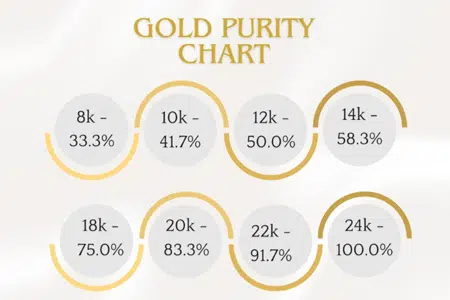
Before we’re going to compare white gold vs yellow gold, we need to know the karat system, this is because 24K gold is too soft to be set with a stone or keep its form, so jewelers will alloy the metal with other metals to make it strong enough to be worn every day.
The karat means the gold content of your yellow or white gold; it determines the value.
| Karat | Gold Content | Other Metals |
| 14K | 58.3% | 41.7% |
| 18K | 75% | 25% |
| 22K | 91.7% | 8.3% |
The Technical Differences: Composition and Purity
Yellow Gold Composition
Gold comes from the earth in yellow form. Jewelers alloy gold with reddish copper for strength, and silver for brightness and durability. These metals allow the gold to retain its yellow color while making the metal durable enough to stand up to everyday use. Higher karat yellow gold, like 22K, has less copper and silver, making the gold look a brighter shade of yellow but more prone to scratching.
White Gold Composition
There is no natural white gold. White gold is created when jewelers take yellow gold, and then they mix certain types of white metals into it, including palladium, nickel, and/or manganese. Even when white metals have been mixed with yellow gold, the mixture will usually look somewhat yellow and/or gray in color.
Rhodium plating is often applied after white gold is created. This layer is responsible for the bright, shiny silvery-white color associated with white gold, as well as the added resistance to scratches.
Over time, the rhodium plating will wear down, which means that white gold needs to be taken care of properly. Click here for more information about rhodium-plated jewelry vs. gold-plated jewelry.
Color and Tone Difference
Yellow gold has a warm, rich, buttery appearance and is old-fashioned in nature. It has a reflective characteristic. Meanwhile, white gold appears cool and silvery white in hue and modern in style. It has a less obvious skin tone and allows the stones themselves to make the statement.
There is no clear favorite between the two; each also serves its own purpose. If you are someone who likes to wear a mix of gold and silver, check out a few easy tips on how to combine the two.
Skin Tone Matching Difference
Your skin undertone influences your choice of gold.
Yellow gold suits warm skin undertones, peach skin, and golden or olive skin. White gold suits cool skin, rosy or pink skin, and pale skin with pink undertones.
For more tips, you can check what jewelry color suits blondes and best jewelry color cool skin tone.
Diamond and Gemstone Pairing Difference
White gold looks best with diamonds that are colorless in the D-F color range and cool stones like sapphires and emeralds. White metal enhances the iciness of colorless stones.
Yellow gold makes diamonds in the G-J yellow tint color range look more colorless, and warm stones, such as rubies and opals, look more compatible. Yellow gold hides the color in diamonds, so yellow metal and warm stone appear natural together.
Durability and Scratch Resistance Comparison
White gold is often plated with rhodium. When the rhodium wears off, the underlying softer gold or other base metal will have visible scratches that appear as dark lines on the white surface.
Yellow gold, on the other hand, is much softer than white gold, and therefore it will show smaller dents and scratches more easily. However, these scratch marks tend to blend into the gold due to its uniform color.
Long-Term Maintenance Comparison
Every 1-3 years, white gold must be re-plated with rhodium. If the item is not re-plated, the yellowish color of the base metal will show through. Therefore, if you purchased a white gold item and kept it for 10 years, you would have incurred additional costs.
Yellow Gold does not require any special care other than cleaning once or twice a year using warm soapy water and polishing. The color of yellow gold does not change or wear off over time.
Hypoallergenic Properties Comparison
White gold contains nickel, which causes itching, redness, and rashes in approximately 10-20% of those who wear it. Higher karat white gold, such as 10K or 14K, has more alloys and thus more nickel. Palladium white gold is typically free from nickel, but usually costs more than white gold that contains nickel.
Yellow gold is generally safer for people with sensitive skin, especially when purchased at higher karats like 18K or 22K. If you suspect you may be allergic to nickel, you should consider purchasing palladium white gold, or only wear yellow gold.
Price and Value Difference
White gold might be expensive because of the rhodium plating and palladium alloys, and the difference is significant over time, because white gold needs to be replated in 1-3 years.
Yellow gold has barely any recurring costs.
Conclusion
Your final choice will depend on the three factors: appearance (warm classic versus cool modern), maintenance (easy clean versus expensive re-plating), and sensitive skin (yellow gold for nickel allergy).
Both hold their value based on karat weight, but yellow gold costs more over time.
OOTB provides gold and white gold-plated silver and stainless steel jewelry at the best price. Feel free to contact us for custom jewelry needs.
FAQs
How to Identify White Gold at Home
Inspect the jewelry band or clasp for stampings. White gold is stamped “14K,” “18K,” or the number of karats, as well as “WG,” “white gold,” etc. Read on our page for the different jewelry stamp meanings.
Compare with actual sterling silver – white gold becomes warmer and slightly more grayish when the rhodium wears off.
How is White Gold Made White
White gold starts off with the yellow gold being mixed with various white metals, and the process of mixing them together changes the yellow color to a lighter version of the yellow color while still maintaining a hint of grey. In order to obtain the final result of the silvery-white appearance Jewellers apply a finish of rhodium plating over the finished yellow and white gold mixture.

 English
  French
  Spanish
  German
  Russian
  Turkish
  Portuguese