


Introduction: The Golden Dilemma
You come across a gold necklace on the internet that seems to be a near replica of the authentic necklace — same warm tint, heft, and polished appearance. However, its classification hails it as “stainless steel.”
Is stainless steel gold fake?
The short answer: no. Gold stainless steel is definitely not fake. It belongs to another category of jewelry made of metal, with the coating process performed over it.
No matter whether you’re going shopping for individuals or purchasing for your business, it’s important to know what you’re actually buying.
What Exactly Is Gold Stainless Steel?

Gold stainless-steel jewelry consists of a base and a gold finish coating.
The base material is nearly always 304 stainless steel, which is a non-reactive metal to human skin. It has been shown to have excellent strength and rust resistance and is also considered one of the most non-irritating grades of stainless-steel jewelry.
The “gold” aspect of the jewelry is derived from a coating applied to the exterior, and the most durable method for applying that coating is through a process called Physical Vapor Deposition (PVD). During this procedure, gold particles are vaporized into a vacuum chamber and then chemically bonded to the surface of the steel through a molecular-level bond. In addition to the fact that this process is not simply a dipping or painting, but the chemical bond is formed at a very deep level, and can withstand wear and tear easily.
Is Gold-Plated Stainless Steel Fake?
It’s absolutely not fake. Stainless steel with gold plating is a good alternative to solid gold as it offers a lower price while being tougher.
For example, gold-filled jewelry has a thick layer of real gold over a base metal; they are both considered real jewelry. Gold stainless is just like gold filled, only with a stronger and more durable base.
The base material of gold stainless steel is stainless steel, while gold-filled is often applied on brass or silver; this is the key difference. If someone sold this piece and say it as “solid 24k gold”, then it’s considered fraud.
However, if you see the label say, gold plated stainless steel” or “PVD gold,” then the seller is being honest.
The Process of Gold Stainless Steel Jewelry
Two main methods put the gold color onto stainless steel: PVD and electroplating. They produce similar results on the surface, but the quality difference between them is significant.
PVD (Physical Vapor Deposition)
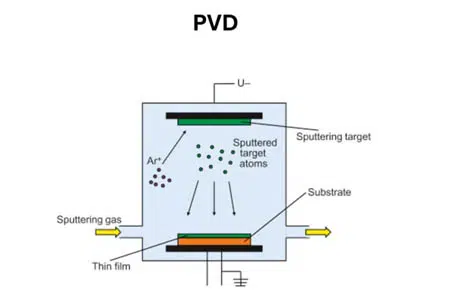
In PVD, the stainless-steel component is installed inside a vacuum. Afterwards, gold (often a mixture of gold and titanium nitride (TiN) metal) is heated to the point where it starts to vaporize. Gold then fuses with the steel on a molecular level.
Such an attachment is extremely strong. The gold is not just deposited on the surface; it is bonded with the steel. It is the reason PVD jewelry is much more durable than similar jewelry made by other coating methods. The TiN film provides additional hardness for the PVD pieces, keeping the color safe from scratches.
Electroplating
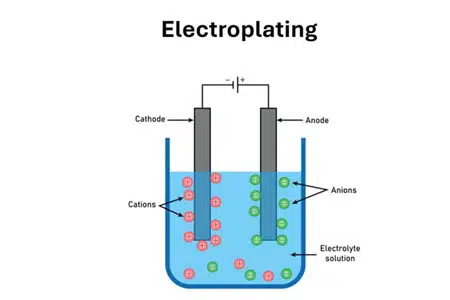
Electroplating is done differently. The stainless steel part is placed in a liquid solution that has gold ions in it. A current is passed through the solution, which forces the gold ions onto the steel surface to create a gold plate.
The issue is that the bond is weaker because the gold does not actually meld at the molecular level like PVD, and it rests closer to the surface. Throughout time, especially through daily wear, sweat, or any contact with water, it rubs off and will also discolor.
For a direct side-by-side look at both methods, check out this guide on PVD vs electroplating.
If you prefer more durable stainless jewelry with gold plating, consider PVD. And ask the supplier which plating they’re using.
How to Identify Whether Stainless Steel Gold Is Real?
The Fischer Test and X-ray Fluorescence (XRF) Testing System provide two of the most effective ways of verifying the legitimacy of a gold plate.
Both the Fischer Fume Test and X-ray Fluorescence (XRF) Testing System perform an analysis of the metal content from top layer to bottom layer without damaging the piece. A test performed in a professional laboratory will issue a report that indicates the gold content of the piece as ‘AU’ — the symbol for gold on the periodic table.
If AU is identified as appearing in any layer of the report, then the coating is legitimate gold. If it is not seen, then the coating will be a chemically plated ”gold’-colored material with no actual gold contained in it.
Familiarity with how to read the jewelry stamp meanings on finished pieces will also provide you with an indication of the intended metal composition and coating type prior to receiving or testing any of their products.
Pros and Cons: An Honest Breakdown
The Upside
Gold stainless steel is hypoallergenic, durable, and scratch-resistant, allowing you to wear it every day without worrying about sensitive skin or visible scratches.
It is identical in color and texture to 14k or 18k gold, and you will hardly work with it — no need for the polishing kit and dust bags.
If you want jewelry that appears to be in gold and suitable for all wear and tear during everyday life, then you are most welcome.
The Downside
Steel has a higher density than gold, meaning that steel jewelry will typically be much heavier than an equivalent piece made from gold.
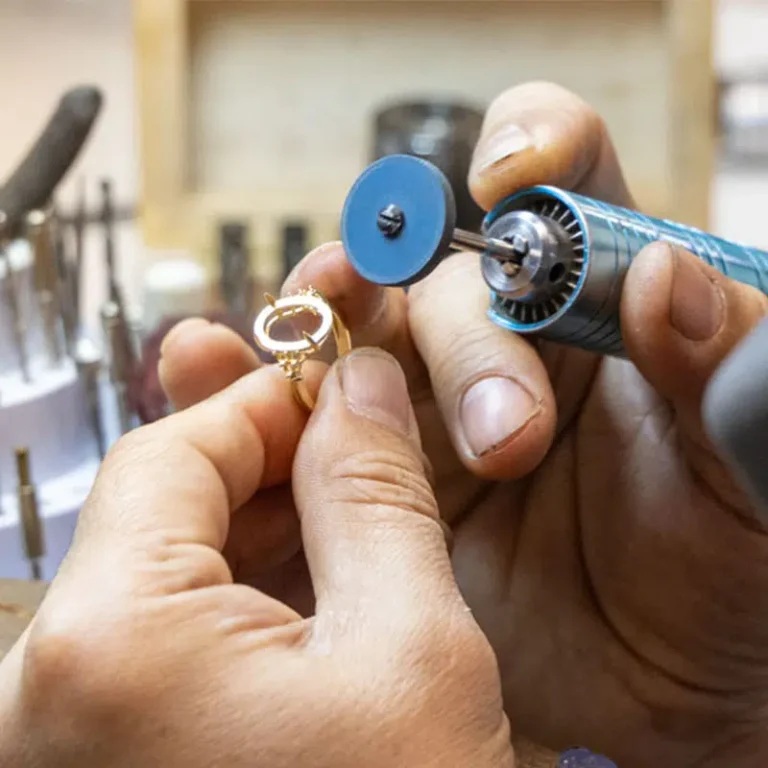
A majority of traditional jewelers do not have the tooling to resize or repair steel jewelry, as the equipment needed to work with steel is different than that of gold.
Steel has no financial value & has no melt value or resale market, therefore if you plan on ever selling or handing it down to someone in the future, it won’t hold its value like solid gold does.
How to Make Stainless Steel Gold Plating Last Longer?
Choose 304 or 316 Stainless Steel
Not every type of stainless steel has equal properties for jewelry.
Stainless steel that is of lower quality can have tiny surface flaws, which reduce the strength of the connection between the gold plating and the base material, ultimately resulting in premature peeling.
304 and 316 are the best qualities available for jewelry, because they offer the greatest amount of corrosion resistance and strength. They have dense, smooth surfaces that make it possible for gold to be plated onto them. As a consequence, the gold plate will adhere better and last longer on 304 and 316 than on lesser grades of stainless steel.
Jewelry made of 304 and 316 can be submerged in water and remain unaffected.
Smooth Surface Preparation
The stainless steel must be thoroughly polished before gold can be applied. If the surface is uneven, the high spots will lose their coating as the gold plate chips off, and the low spots will have no coating or an uneven surface and will appear imperfect.
When the surface is buffed correctly, gold has a more even, level surface to bond to, resulting in a smoother surface that is less likely to become marred as quickly through daily use.
Conclusion: Is It “Fake”?
Gold stainless steel only qualifies as ‘fake’ if it is offered to you as being solid 24k gold.
By itself, it is a real, legitimate product manufactured with authentic materials and a bona fide process. It is trustworthy, skin-friendly, cost-effective, and just plain handsome; this is your reason for its growing popularity within jewelry as a natural choice for daily adornment.
OOTB Jewelry is the China manufacturer that supplies gold stainless steel jewelry wholesale for you. You can send an inquiry to us for good PVD gold stainless jewelry with a competitive price.
Is Stainless Steel Gold Valuable?
Gold stainless steel doesn’t have melt value or resale value like solid gold. You can’t just take it to the gold shop for a cash payday on weight.
But it is a good value as fashion jewelry- you get the advantage of gold for a fraction of the price and better durability than the competition in the same price domain. It is hard to find a better value in jewelry for regular wear.
What’s the Lifespan of Gold Stainless Steel Jewelry?
It depends on the plating method.
PVD (Physical Vapor Deposition) plated pieces can withstand 3 to 5+ years of wear and tear due to their ability to form a molecular bond with gold and be resistant to scratches.
Electroplated pieces are only good for approximately 6 months to 2 years of daily wear depending on the type of environment you live in and how frequently they come into contact with water, sweat or chemicals.
 English
  French
  Spanish
  German
  Russian
  Turkish
  Portuguese