

Introduction
Is gold jewelry waterproof? Can you wear gold in the shower, or at the beach? The answer is not a simple yes or no. It simply depends on the type of gold jewelry and the type of water.
Pure gold is perfectly fine in the water, but the problem is that most jewelry is not pure gold.
This guide will give you some clear answers so you know when you can keep your gold on and when it’s time to take it off.
Is Gold Jewelry Waterproof?
Pure, 24-carat gold is completely waterproof. As a “noble metal,” it does not react to oxygen or water. So pure gold will never rust, tarnish, or corrode. You could wear that jewelry made of 24k gold in any water and not worry about it.
However, jewelry is almost never made of pure gold. 24k gold is too soft to make jewelry because you could easily bend a pure gold ring with your fingers. So to make the gold strong enough for normal wear, jewelers mix gold with other metals, such as copper, silver, and zinc. This mixture is called an alloy. These additional metals could react with water and chemicals, which is why some gold jewelry cannot be worn in water.
What Kind of Gold Jewelry is Waterproof?
Solid Gold
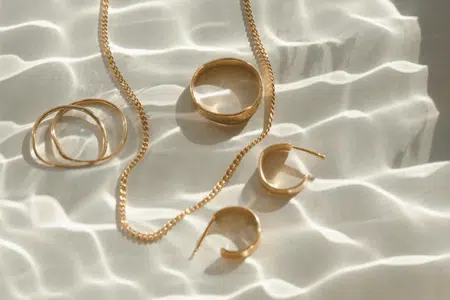
Solid gold jewelry is okay to wear in the water. For instance, a 14k solid gold ring is 58.3% gold and 41.7% other metals, from the surface of the ring all the way to the center. Since gold exists throughout the entire item, solid jewelry at a karat of 14K or greater is very strong and water resistant. You can wear it in the shower with very little worry.
Gold Filled Jewelry
Gold-filled jewelry consists of a layer of solid gold that has been bonded under heat and pressure to a base metal, typically jeweler’s brass. Since the gold layer is considerable, making up at least 5% of each piece’s total weight, this outer shell provides protection to the base metal which means that gold-filled jewelry is waterproof against water, as long as the gold layer is at least 14K.
Gold Vermeil
Gold vermeil is a type of gold plating jewelry, which has a thick layer of gold (at least 2.5 microns thick) over sterling silver. The question “is gold vermeil waterproof?” often arises. Since gold vermeil has a thicker layer of gold than regular gold plated jewelry, and the base metal is a quality sterling silver (one of the several types of silver), it will tolerate a splash or small rinse occasionally versus other gold plated jewelry. However, gold vermeil should not be worn in the shower too often as the gold layer will eventually wear away.
The Big Exceptions: Gold-Plating
Jewelry that is gold-plated has a very thin layer of gold on top of a base metal such as brass or copper, and that layer is often less than 1 micron thick.
So, is gold-plated waterproof? The answer is absolutely not.
Water, and especially if it is mixed with soap or chemicals, will wear away that thin plating quickly. Once the gold is gone, you are left with the low-cost base metal underneath, and that will tarnish, rust, or even turn your skin green. It does not matter if it is labeled 14k gold plated or 18k gold plated. The issue is the thin layer! So if you want your plated jewelry to last, take it off before your hands get wet!
Understanding Karats: The Key to Water Resistance
sciencedirect.com indicate if the k (karats) of gold jewelry is lower 14K, it is easy be corroded. The rule is variable: The higher the karat, the more pure gold the item contains and the safer it is in water. The numbers you see on your pieces are important jewelry stamp meanings.
| Karat | Gold Purity | Water Resistance Summary |
| 24K | 99.9% Gold | Excellent. Fully waterproof but generally too soft for most jewelry. |
| 18K | 75% Gold | Very Good. Safe generally in pure water; the high gold content protects the alloys. |
| 14K | 58.3% Gold | Good. The best durability and purity balance. Good for water exposure. |
| 10K | 41.7% Gold | Fair. More alloy metals means it can discolor overtime when exposed to water repeatedly. |
Not All Water is Created Equal: A Breakdown of Risks
The research from springer.com and pubmed.ncbi.nlm.nih.gov show that pure water is safe to gold, but if the water contains chlorides, acids, or other reactive specie, things changed.
So, the kind of water your jewelry has come into contact with is equally important as the jewelry itself.
The Shower (Tap Water)
The issue here in the shower isn’t really the water itself, but your soaps, shampoos, and conditions. These can leave a grimy film upon your gold jewelry, and any gemstones. This film can therefore build up over time, making your lovely pieces appear cloudy, and it won’t sparkle either. And hard water can leave mineral spots.
The Swimming Pool & Hot Tub
Chlorine is gold jewelry’s worst enemy and it is found in lots of pools and hot tubs. Chlorine is a strong chemical that can react with the alloy metals in your jewelry (especially copper in rose gold). In reaction to chlorine, discoloration can develop and over time, make the structure of your jewelry weaker (especially the prongs that hold the stone). Always remove your gold jewelry prior to getting into a pool or hot tub.
The Ocean (Saltwater)
Salt is a source of corrosion. Just like it will rust your car, saltwater will gradually erode and corrode the alloy metals in your gold jewelry, and impact the solder joints where the piece was joint together. There is another huge risk, which is cold water. When you dip into the cold ocean, your fingers will shrink! I have heard so many stories of clients that have lost their rings in the waves, just because the ring slipped off their smaller fingers. In the end, it’s really not worth the compromised risk.
A Final Word on Gold and Water
Actual gold is waterproof, however in jewelry, we mostly see just a gold alloy, which is a mixture of gold and another metal. The higher the gold content (karat), the better the alloy will withstand water. The best thing to do here is choose at least 14K or higher.
For water resistant jewelry options, OOTB also offers Premium PVD gold plating which is much tougher than the standard plating option. Please reach out to us to discuss your project.
FAQs
What Gold Jewelry Can I Swim In?
You should generally refrain from swimming in any type of gold jewelry. Chlorine from pool water can attack the alloys, and saltwater is corrosive. Additionally, there is a high risk of losing your jewelry in the ocean or a lake! If you have to swim with your jewelry, solid 14K or 18K gold can handle the conditions best, but it is still risky.
What Jewelry Can I Shower In?
You can confidently shower wearing solid gold jewelry, as long as it’s 14K or higher. Gold-filled items are also generally fine. It can leave a soap-and-shampoo residue over time, so you will have to clean it. Gold vermeil is best removed before showering—and it is always best to remove gold-plated before showering.

 English
  French
  Spanish
  German
  Russian
  Turkish
  Portuguese