


Introduction
Lots of retailers purchase inexpensive PU leather bracelets, believing they will hold together, then are faced with the anger of their customers six months down the road when the strap peels.
Here is the truth: faux leather is not one material. It is a category that includes everything from flimsy plastic to automotive-grade fiber composites.
The answer to the question “How long does faux leather last for a bracelet?” It is hard to say, it varies from 6 months to 5 or even more years based on what you actually source.
This guide will talk about three tiers of synthetic leather for bracelets and other factors that will affect the lifespan of your bracelet and tips for maintenance that you can share with your client to improve it.
The Main Factor That Affects Its Lifespan
The quality of the materials determines it all. Here is a comparison of low- to high-quality faux leather for bracelets.
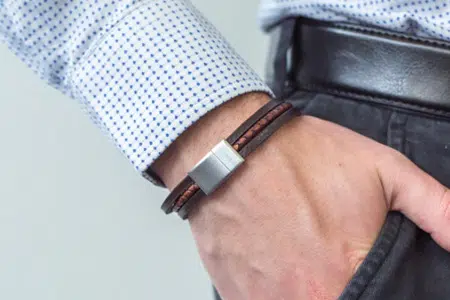
Tier 3: Bonded & Standard PVC
Lifespan: 6 – 12 Months
It’s the material of choice for fast fashion accessories. The makers take a rigid plastic sheet and glue it to a thin mesh backing. It may look leathery from a distance, but it is hard and inflexible.
Why it fails very quickly: PVC has no flex memory. Each time the bracelet makes a bend on someone’s wrist, micro-cracks are formed to the plastic coating. After a few months of daily wear, you can usually see the cracks clearly. The plastic coating begins to separate from the mesh.
Tier 2: Standard Polyurethane (PU)
Lifespan: 1 – 2 Years
PU leather is softer than PVC and is more flexible. This is what the majority of department stores use for fashion jewelry. The material feels acceptable to the touch when new and costs less than real leather.
Why it fails anyway: PU is porous and absorbs moisture. When someone wears a PU leather bracelet to the gym or any other setting with increased humidity, water molecules are pushed through the coating. This will begin to cause a chemical reaction known as hydrolysis. After hydrolysis, the surface becomes tacky, and shortly after that, it will begin to break down.
Most PU bracelets look good for the first year. Year two is when the issues appear. The strap becomes tacky to the touch. The coating will rub off, and the strap goes from smooth to rough in texture.
Tier 1: Microfiber Reinforced Leather
Lifespan: 3 – 5+ Years
Microfiber leather has a different construction. Rather than simply coating a fabric with plastic, the manufacturer creates a 3D structure with non-woven fibers. These fibers are bonded with high-grade polyurethane resins at a molecular level, replicating the way collagen fibers work in real animal hide.
This structure provides tensile strength, and the high-grade resins are surface energetics, resisting penetration of water. Moreover, the material flexes and holds up without developing stress points of failure.
The same material is used in luxury automobiles and high-end furniture. So if a sofa covered in microfiber leather can withstand daily use from a family of kids for a decade, and car seats daily for ten years, we can safely assume the material is over-engineered for a bracelet that weighs in at 30 grams.
Other Factors Affecting Lifespan
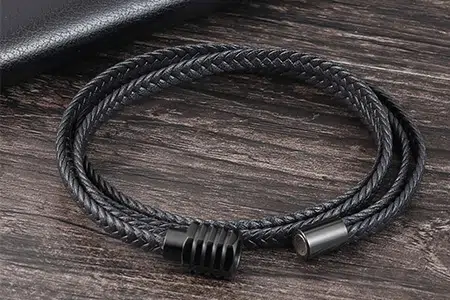
Material grade is the most important factor, but not the only factor. Even premium microfiber can break down faster in the wrong circumstances. Understanding these factors can help you set reasonable expectations with your customers.
Hydrolysis (The “Sweat Factor”)
Here is the example: Someone puts on their bracelet when they go to the gym. They sweat, and the sweat gets into the material’s pores. Due to the moisture, a chemical reaction occurs, breaking the bonds holding the coating together. After many gym sessions, they see damage to the bracelet, either stickiness or peeling.
The difference in materials: Standard PU acts like a sponge. It will absorb the moisture and hold it against the polymer structure. Microfiber leather has a hydrophobic (water-repelling) surface. This causes the water to bead and roll off instead of getting soaked in. This one difference can double the life of a bracelet worn by an individual who regularly exercises.
pH & Body Chemistry
Human skin has an acidic pH level of between 4.5 and 6.5. Everyone also produces oils called sebum. Both of these sources of breakdown will attack synthetic materials over time.
The breakdown process is chemical. Acidic sweat and oily residues slowly degrade the resin coating on the faux leather. The process is gradual, but it is constant and continues.
Comparison with real and fiber leather: Real leather absorbs these oils, which is why real leather develops a patina over time and can smell bad as old leather builds up oils. Microfiber leather does not absorb oils, so they remain on the surface and can be wiped away instead of absorbed into the material.
Mechanical Stress (Flexion Fatigue)
The bracelet will flex every time someone moves their wrist. Over a day’s time, that’s thousands of flex cycles. Over the period of a year, that’s hundreds of thousands of flex cycles.
Where stress concentrates: The points near the bracelet clasp experience the most stress. Every time the wrist bends, these parts flex additionally to the rest of the strap.
Material reaction: Rigid materials such as PVC have no flex memory, they just crack. Regular PU is slightly better but you will develop weak spots over time. Microfiber leather has a non-woven fiber structure that allows for load to be distributed across the material rather than concentrated in one location. The fibers can move slightly, then return to position without damage.
Think of it like the difference between bending a plastic ruler (which snaps) and bending a piece of fabric (which returns to shape). The fibre structure in microfiber leather works more like fabric than plastic.
Chemical Exposure
Synthetic leather can be harmed by colognes, lotions, cleaners, and chlorine. The worst offender is alcohol, because it removes the protective finish on the surface of the material.
Example: A person sprays cologne on while wearing their bracelet. The alcohol in the cologne touches the strap and dissolves part of the surface coating. The finish dulls and becomes rough after multiple exposures. In extreme cases, the coating can completely peel off.
Pool chlorine and saltwater are similarly harsh. They are designed to break down organic materials, and they will also harm even water-resistant materials with repeated exposure.
Educating Your Customer – How to Extend Service Life
Even the finest materials require attention when caring for them. Use these ideas with your customers to extend the product’s life even longer – from 3 years to 5 or more years. This reduces returns while building customer loyalty because their jewelry continues looking great.
Tip 1: The ‘Last On, First Off’ Rule
Always put on jewelry after applying cologne, lotion, or other products. Do the reverse before bedtime – always take off jewelry before applying these items.
Why this works: It limits direct contact with the chemicals. If the cologne is on the skin first and the bracelet goes over it – the alcohol already evaporated. The bracelet never touches the concentrated chemical. This simple switch in timing removes most of the contact with the damaging chemical.
Tip 2: The Post-Wear Wipe Down
After wearing the bracelet, particularly after exercise or on a hot day, all you have to do is wipe it with a slightly damp cloth. This takes 10 seconds.
What does this prevent? This will remove salt from sweat that has dried on the bracelet and any oils that have built up during wear. Salt is corrosive. Oils can break down the resins in the leather. Removing them before they sit on the material overnight prevents the slow accumulation of damage that leads to hydrolysis.
This is particularly important for braided leather bracelets, where sweat can be trapped between the braided sections.
Tip 3: Avoid ‘Deep Diving’
Water-resistant does not mean “pool-proof,” so please take bracelets off before swimming in chlorinated pools or in the ocean.
Chlorine is a more aggressive oxidizer; it’s purpose is literally to break down the organic material in pools. Salt is similarly aggressive as it leaves behind salt crystals that function like little abrasives. While microfiber leather can get wet from a quick hand wash or rain, being submerged every day in chemically treated water will expedite wear.
If customers are looking for jewelry they can wear swimming every day, simply suggest stainless steel materials rather than any leather material.
Sourcing for the Long Haul
Reducing return rates is not a matter of chance; it is about sourcing your materials to meet the real-world wear patterns. The difference between a 6-month bracelet and a 5-year bracelet is all about the quality of the material and maintenance.
OOTB specializes in automotive-grade microfiber leather bracelets for the jewelry market. We are a manufacturing company based in China with 10 years of exporting experience and over 500 different leather bracelet styles.
If you sell a leather bracelet to your client, stop gambling with standard PU that causes complaints after a couple of months. Request our microfiber stainless steel collection sample kit to put your hands on the material and feel the difference in thickness and texture.
 English
  French
  Spanish
  German
  Russian
  Turkish
  Portuguese