

Introduction
Microfiber leather vs real leather: which is better for a bracelet? There is no clear winner in terms of material. The question is which material is best for you.
This guide compares both from 9 main points to help you make the selection that is best for your needs regarding a business.
What Are They? Defining the Two Materials
Real Leather
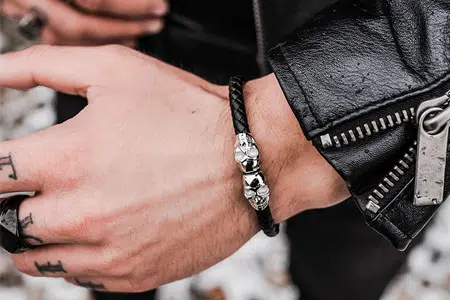
Natural leather is produced by tanning animal skin. Full-grain leather has all of the natural markings and pores of the upper layers. Top grain leather has had the surface sanded slightly. Both types have their variations in that there are different thicknesses of a single hide and different ways that color is absorbed depending upon the different densities of the fibers in the different areas of the hide.
Microfiber Leather
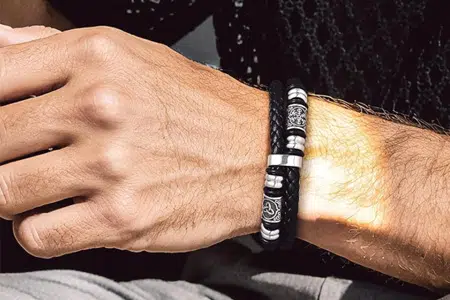
Microfiber leather is constructed of a multitude of little synthetic fibers that are laminated together and coated with a layer of polyurethane resin. The leather is manufactured not grown which gives it the characteristic that every inch has the same thickness, density and structure. The manufacture does not involve animal products and is made entirely of synthetic substances in a controlled factory situation.
Head-to-Head Comparison: The 9 Key Metrics
Durability & Strength
Real leather is very strong even in tensile strength, especially full-grain leather. It is not prone to tearing and wears well under the stresses of daily use. After years of use, a patina develops, an appearance of wornness where the leather becomes dark and soft and develops usage patterns of concern.
Microfiber leather is extremely good for abrasion. When it is treated repeatedly, or at the same flex point, it maintains shape through thousands of bends. Unlike real leather, it does not develop a patina. It will look almost precisely the same after years of use as it did when new.
Consistency & Structure
Real leather exhibits variations in its natural thickness. A portion might be 2mm while another can be 2.5mm. Patterns of the grain and absorption of color vary, due to the non-uniformity of the structure of the fibers. In braided leather bracelet designs this becomes a difficulty as the several strands must be a uniform thickness.
Microfiber leather shows uniformity in the thickness, density and structure throughout. When we cut strands for our braided collection each behaves normally in the assembling process. Coloring is uniform throughout. This is very important in complicated designs where the variations could be seen.
Aesthetics & Aesthetics (How They Look)
Real Leather is characterized by its individual natural texture and grain patterns. There is a distinctive smell. As leather darkens in those areas met by skin, the patina produces a quality that adds depth to the view. For distressed leather roamers and classic styles, this natural look is what the public wants. The faults make each piece different.
Microfiber Leather gives a uniform surface which takes dye extremely well giving deep rich color. Good surface area is stable for embossed textures—we can stamp crocodile pattern, snake scales, lizard skin—and it retains detail sharply without natural pores interfering.
Resistance & Maintenance
Real leather requires protection from moisture. When wet, the fibers become stiff or damaged. The salts and oils in sweat destroy leather over time. It requires regular conditioning from leather cream to remain flexible. Without attention, it will become dry and cracked. Real leather requires special treatment if it is to be worn for sport or in the humid heat of the day.
Microfiber leather is more resistant to moisture. The moisture will bead on the surface. The synthetic fibers are not destroyed by the moisture in sweat. Maintenance is easy, a damp cloth suffices. Thus, it is ideal for leather bracelets to be worn during sporting activity or when it is raining.
Cost & Sourcing
Real leather is more expensive at every process of production. Hides must be secured, and the prices are variable. Tanning the leather takes weeks or months. Labor is substantially more expensive because workers must be skilled to grade and cut hides. This added expense makes real leather bracelets more expensive to make.
Microfiber Leather is less expensive. The synthetics are made in controlled situations where quantities of products can be predicted. The time involved in producing the products is less. The yield is better for material—we can use nearly 100% of the sheets, while in the case of real leather, there are unusable sections in the hides.
Environmental & Ethics
Genuine Leather is a by-product of the meat industry, derived from animals. Tanning has traditionally used chromium salts and chemicals, although vegetable tanning is a natural alternative. Genuine leather is biodegradable. The choice is one of brand values.
Microfiber Leather is 100% vegan and cruelty-free. No animals are used at all. Modern production has reduced reliance on chemicals. For brands whose philosophy is to avoid products made from animals, using microfiber is a simple way to show the positive alternative.
Colorfastness
Real Leather tends to fade in sunlight. Some colored leather will bleed a little when wet, dyeing the skin. Natural fibers don’t hold color as tightly as synthetics.
Synthetic fibers bond with color when they are made, and a resin coating holds the color in. The sun can’t fade colors. There is no bleeding of dye. In a few years, the bracelet will look the same as when it was new.
Comfortable
Genuine leather is naturally breathable. The fiber structure promotes air circulation. As your body warms it, the leather becomes more pliable and shapes slightly to the wrist, giving a custom fit.
Microfiber leather has a smooth feeling and soft texture manufactured in it and has no break-in period at all. The material is also lightweight; however, it is not breathable. This is because the synthetic surface does not allow as much circulation of air.
Applications
When the natural character of the leather matters most, I recommend using real leather. The distressed collection uses full-grain leather, because patina and aging will define these strap bracelets. Classic minimalist designs will maximize the leather’s natural beauty.
Choose microfiber for performance designs. Microfiber will perform better with water resistance or in conditions of wearing the leather in sports or outdoor conditions.
Conclusion
Genuine leather and microfiber leather make excellent materials for men’s bracelets. Go with genuine leather if you want a natural texture, breathability, and a beautiful patina with age. Choose microfiber leather if you want water resistance, color consistency, and low-maintenance wear.
At OOTB, we use both types of materials strategically across the 500+ styles of leather bracelets we carry. Contact OOTB Jewelry with an inquiry, and our team will help you decide on the best material for your design.

 English
  French
  Spanish
  German
  Russian
  Turkish
  Portuguese