

Introduction
Not all gold jewelry will remain shiny forever. Some pieces will tarnish and turn green or black or lose their sparkle after a few short months. The reason is simple: different types of gold respond differently to air, water, and the oils from our skin. Pure gold itself will never tarnish or change color, but most jewelry has metals other than gold.
This guide will tell you what type of gold doesn’t tarnish and will help you choose jewelry that will maintain its appearance for years.
The Science of Tarnish: Why Gold Sometimes Changes Color
Tarnish occurs when metals react with oxygen and sulfur in the air. Tarnish is similar to rust on iron, but not the same. Pure gold is a special case because it is “noble metal” – it will not react with either air or water. That is why coins made of gold buried underground for hundreds of years still look just as they did when buried.
The difficulty lies in the fact that we make gold stronger by combining it with other metals called alloys. Alloys are what leads to tarnished gold jewelry once the metal reacts to air, water, sweat, or chemicals.
Common Types of Tarnish
Scratches
Scratches are not a chemical change but they can make gold look old and dull. When jewelry is scratched, it can lose its mirrored shine. Light will bounce off the scratched surface differently – which can make real gold look like cheap metal. And the reason why it happens is the hardness of the gold.
| Type of Gold | Scratch Resistance | Reason |
| 24k Gold | 2 Stars | Too soft |
| 18k Gold | 3 Stars | Balanced hardness |
| 14k Gold | 4 Stars | Harder alloy mix |
| 10k Gold | 5 Stars | Hardest but less gold |
Turning Black or Green
When gold-plated jewelry has a silver or brass base underneath, those metals interact with the air and our skin’s oils. This is because the thin gold plating can’t protect the base metal forever.
Green marks on the skin can come from copper in the base metal. The black tarnish usually comes from the silver reacting with sulfur in the air. Both of these problems will happen faster in humid areas or when you sweat a lot.
The Golden Spectrum: Understanding Karats
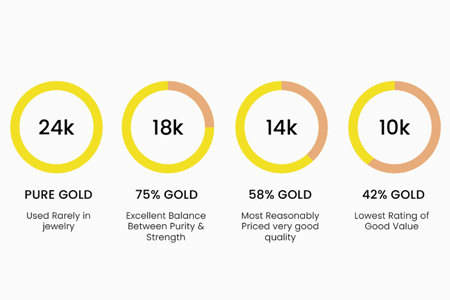
The karat system indicates how much pure gold is in your jewelry. As the number gets larger, the gold content increases, as does the resistance to tarnishing.
| Karat | Gold Content | Other Metals | Tarnish Risk |
| 24k | 99.9% pure gold | 0.1% trace metals | Never |
| 18k | 75% gold | 25% alloy metals | Very Low |
| 14k | 58.3% gold | 41.7% alloy metals | Low |
| 10k | 41.7% gold | 58.3% alloy metals | Medium |
There is a straightforward principle: the lower the karat number, the more gold is mixed with other metals. When you have jewelry that is made of more than 50% other metals (for example 10k gold), the other non-gold metals will eventually tarnish.
What Gold Jewelry Doesn’t Tarnish Easily?
Solid Gold 14K & Above
Solid 14k gold is 58.3% of pure gold, which is an sufficient barrier against tarnishing. The other metals are protected by the gold, and with daily wear and proper care, this jewelry can potentially last for decades looking new.
18k gold is even better, since it is 75% gold. Having more gold and fewer reactive metals is also better. This is why many luxury brands use 18k gold in their pieces as a standard.
Gold-Filled
Gold-filled jewelry has an actual layer of gold that is attached to a base metal. Under law, gold-filled jewelry must contain at least 5% gold of the total weight. Because of this, even regular gold plating simply can’t be as thick as gold-filled jewelry.
The gold layer in gold filled jewelry is about 100 times thicker than regular gold plating. This means that it would almost be impossible for the base metal to show through, even after many years of wear.
PVD Gold Plated Jewelry
PVD is Physical Vapor Deposition which utilizes a unique method to create a very strong bond between gold and the base metal. The coating of gold is applied in a vacuum chamber that introduces electrical fields.
OOTB use PVD coating for jewelry, because it creates jewelry that has the same looks of a solid gold piece at a much lower cost. Our PVD gold plated jewelry is typically lasting over 2 years with day to day use, which is significant longer than standard gold plating.
Which Gold-Plated Base Metal Jewelry Does Not Tarnish?
A base metal of stainless steel is the best for jewelry that is gold plated. Here is why:
- It will never rust or corrode – stainless steel is engineered to withstand all metal reactions
- It can act as a barrier – keeping your skin protected from possible reactions with the metal
- It’s an extremely strong base metal – it will NEVER bend or break like cheaper metals
When stainless steel is coupled with PVD gold plating, you have gold jewelry that will look like much more expensive jewelry, and will never tarnish, even in swimming pools, or showers. You are left with true non tarnish gold jewelry at a much lower price point.
Check out the lifespan of gold-plated jewelry, and learn more.
The Most Common Offenders (and How to Protect Them)
Many people tend to buy 10k and 14k gold instead of higher karat gold because these options are usually cheaper than the higher karat gold. These lower karat gold options will oxidise and tarnish more than higher karat gold because they contain more reactive metals.
Here are ways to protect lower karat gold:
- Take off jewelry before jumping in the pool or hot tub- chlorine destroys gold plating quickly
- Take off jewelry before taking a shower, soap and shampoo contain harsh chemicals
- Store in dry sealed containers- the air and moisture will create tarnishing
- Clean with soft cloth only- harsh cleaners will damage protective coatings
- Put on perfumes and lotions first (let dry before putting on jewelry)
- Don’t sleep in your jewelry- sweat and movement will create wear
Following these simple steps will keep their jewelry looking brand new 3-4 times longer than individuals that do not.
Conclusion
Pure gold does not tarnish, but most jewelry has other metals within the composition that will tarnish over time. The higher the karat the less the chance of tarnishing. For best performance and cost, buy 14k gold, gold filled, or PVD gold plated jewelry on stainless steel.
OOTB carries well made gold-plated jewelry that will last more than 2 years at a competitive price, while getting you the gold look without the expense of the pure metal.
FAQs
Does gold-plated jewelry tarnish?
Regular gold-plated jewelry does tarnish; the thin coating of gold wears away quickly on regular gold-plated jewelry. PVD gold plated jewelry on stainless steel base can last years with no tarnishing. The thickness of the gold plating and the base metal are the two critical things.
Does 14K gold tarnish?
14K solid gold tarnishes very rarely if properly taken care of. 14K gold is only 58.3% pure gold; the rest of the metal does not usually react with air and moisture because the gold protects it. As long as 14K gold rings and other jewelry are stored properly, best away from warm temperatures and harsh chemicals, they usually stay beautiful for decades.
What Gold Jewelry Can Go in the Pool?
Only wear 18k solid gold or greater in swimming pools. Chlorine will destroy all lower karats of gold and all gold plating in no time. If you want pool friendly jewelry that looks like gold, go for high quality stainless steel gold plated jewelry with a PVD gold plating, although you should still rinse with fresh water after swimming.
What is the Best Value Anti-Tarnish Gold Jewelry?
All PVD gold plated jewelry on stainless steel base provides the best value for non tarnish gold jewelry. It looks exactly the same as solid gold, costs so much less, and lasts in excess of 2 years with daily wear. With this technology you can have beautiful, durable jewelry without the expense.

 English
  French
  Spanish
  German
  Russian
  Turkish
  Portuguese