

Introduction
The choice of leather for your bracelet significantly impacts your business profits. A cheap synthetic leather bracelet may save 0.5USD compared with a higher quality synthetic leather, but if 25% of the customers return their bracelets because of a cracked strap, the initial savings no longer make sense.
Most wholesalers select their leather materials based solely on unit cost, not realizing that the quality of the strap relates directly to repeat orders and client trust.
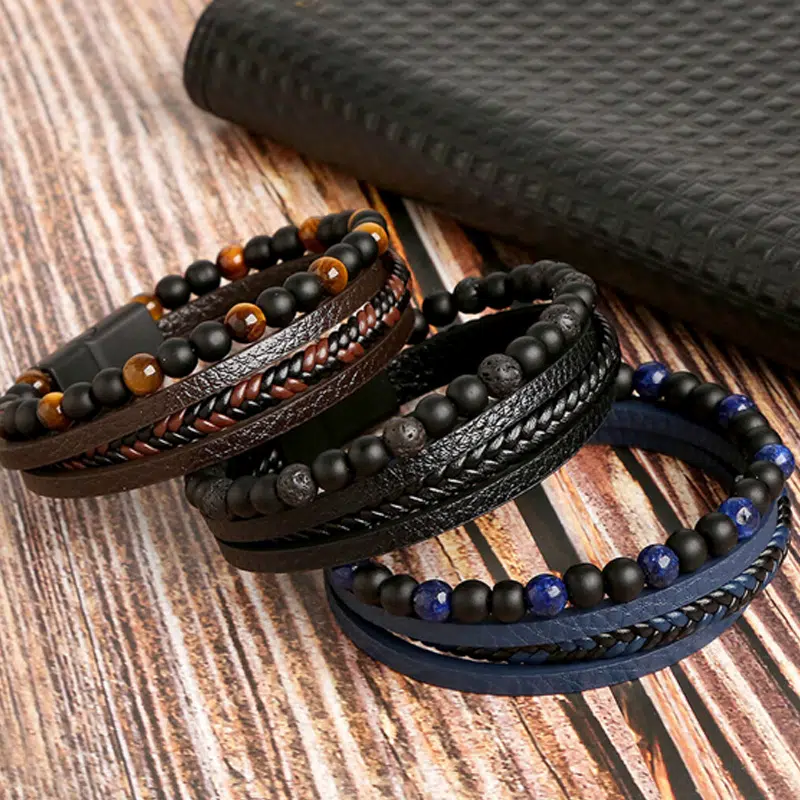
In this guide, we will discuss microfiber leather vs PU leather bracelets. This side-by-side comparison provides you with information regarding which one aligns best with your marketing objectives while minimizing servicing costs to retailers.
Material Structure and Consistency
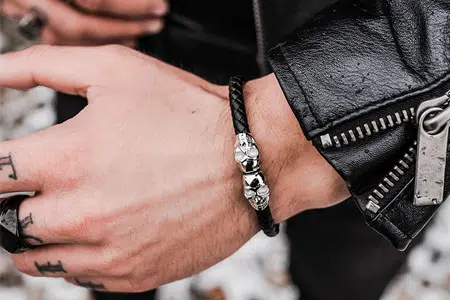
Different types of synthetic leathers have different structures, which affect the way uniformly textured or finished products are made, how well straps perform in production, etc.
PU Leather
PU leather has a polyurethane coating that is placed over inexpensive fabric backs. This coating is very thin and cannot offer enough support. Therefore, using this type of synthetic leather keeps the price low, but you will have a quality problems with this type of synthetic leather.
PU leather has a consistency issue. Inconsistent coating thickness from batch to batch leads to a large amount of variation in finished goods. An example would be a batch measuring 0.3 mm and a second batch measuring 0.5 mm. The surface texture also varies from smooth to bumpy, and there’s a color difference.
If you are planning to order 5,000 leather bracelets. You will find that many leather bracelets will be different from the sample you confirmed before ordering, and you will be in trouble solving the problem. Ultimately, this results in a large time and cost burden on you.
Microfiber Leather
Microfiber leather is composed of a 3D nonwoven material made of ultra-fine synthetic fibers. This base fabric is then coated with a high-performance polyurethane resin, which strongly penetrates the fiber structure, creating a strong bond that holds well.
The engineered base provides consistent support, and the coating penetrates into the base rather than just sitting on top of it. Because the microfiber product is manufactured to very strict tolerances, production control is also very tight. When you purchase it from a leather bracelets supplier, every bracelet in your order will match your original sample.
Consistency is important, as you want every item to be of equal quality. By providing a uniform product, the time spent inspecting finished goods is reduced, and rejection rates are low. The way the material behaves during assembly is predictable, allowing for faster production processes.
Durability and Flex Resistance
This is where material choice directly impacts your return rate. Bracelets bend constantly at the clasp area and around the wrist. Weak materials fail at these stress points.
PU Leather
The material is thin and not designed to flex repeatedly. The polyurethane layer is fragile, and the fabric base offers little to no support. When customers wear PU leather bracelets regularly, they start to see cracks in the strap at the clasp connection in 2-3 months.
The coating pulls away from the fabric. You can see the underlying material, which is quite ugly. If the bracelet has stainless steel components that could withstand many years of use, the strap fails first. This displeases customers who were expecting a much longer lifespan.
These mistakes hurt your company. Customers call retailers to demand replacements. Retailers call you to vent their frustrations about handling returns and losing money. Your name adds bad karma with every strap that breaks. Some retailers may stop ordering because they don’t want the complaints. You saved them $0.50 a lone strap, but by not earning their trust you lose out on hundreds in orders.
Microfiber Leather
The microfibers in microfiber leather bend without breaking. The coating bonds to the fibers, rather than coating the surface. When the straps are bent, the fibers and the coatings bend together instead of separating.
Testing shows the material will survive 50K+ flex cycles before showing damage. That means your customers won’t notice strap breakdown after daily wear for 1-2 years.
Lower return rates mean happier retailers and more reorders from them. You spend less on both customer service and replacements. Your reputation as a quality brand allows for higher prices on the wholesale side. The price difference in the material cost is negligible in terms of value to the business.
Resistance to Hydrolysis and Wear
For skin-contact bracelets, this is a concern because the wearer’s body chemicals can cause rapid decay.
PU Leather
Standard PU leather shows low resistance to hydrolysis. Salts and acids from sweat coming from the customer’s wrist degrade the PU leather coating. Water in the atmosphere accelerates the decay. The coating becomes tacky and eventually “peels” off in flakes.
This issue is more prevalent in hotter climates or with clients who use bracelets while exercising. After 3-4 months the strap’s surface is already sticky. After 6 months, the surface damage is so bad that the bracelet is no longer usable. You cannot position PU leather bracelets as an everyday product because they cannot stand sweat and humidity.
The scratch resistance is also very poor. The thin layer scratches easily with the addition of scuff marks from just normal use on surfaces. After a couple of weeks of wear, PU leather bracelets look dirty and worn out.
Microfiber Leather
Microfiber leather’s resin coating has hydrolysis inhibitors. The material can persistently deal with sweat or moisture without deteriorating. The underlying fibers provide support so even if the coating wears, the underlying design remains strong.
Users can wear microfiber leather bracelets while exercising, in bad weather, or in laborious conditions. The straps remain functional and good as new.
Abrasion resistance is much better. The material will rub against shirts, desk surfaces, or anything else without degrading. Microfiber leather bracelets look good after months of use, and customers continue to wear them.
Aesthetics and Pricing Power
Visual quality determines what tier your product occupies. Based on the visual appeal, customers will perceive your product to be worth a certain price, even before actually touching it.
PU Leather
PU leather looks like artificial plastic. The glare is stiff, and the texture is pretentiously printed. When customers touch it, the PU leather feels cold and rigid.
This design limits your target market. PU leather bracelets cannot compete in the high-quality niche. Everyone can see the materials are bad. You will sell it for low wholesale prices with low-profit margins. Retailers will group the product with bargain options as a price-only competitor.
The look conflicts with superior-quality stainless steel hardware. When you have cheap-looking hardware and nice stainless steel, they look worse. The overall product reads as “mixed quality” rather than cohesive design.
Microfiber Leather
Microfiber leather closely mimics the grain and color depth of real leather. The surface has a natural texture and a soft sheen. Light reflects off the material in a way typical of genuine leather. It feels soft and warm to the touch.
This makes it possible to place your products in the mid to high price range. Retailers can place your microfiber leather bracelets alongside genuine leather bracelets, and no one will be able to tell the difference. Your wholesale prices can be 40% to 60% higher than PU leather and still allow retailers to make substantial profits.
Microfiber leather with good stainless steel feels consistent and high-quality for the whole bracelet. This means higher perceived customer value and higher pricing.
Conclusion
The lowest upfront cost is rarely the lowest total cost. PU leather’s low upfront cost gets offset by high return rate and damaged retailer goodwill. Microfiber leather has a high unit cost but low return rates and consistent quality.
OOTB combines stainless steel with a microfiber leather bracelet. Ready to cut your return rate and have more leather bracelet styles? Talk to us about our stainless steel microfiber leather bracelet catalogue.
 English
  French
  Spanish
  German
  Russian
  Turkish
  Portuguese