

Introduction
How long does PU leather last for bracelet? Many jewelers are worried about it, as it will not only waste money, but also it will destroy their brand if there’s a quality problem.
A short explanation is that high-quality PU leather for the bracelet lasts 2 to 5 years. Poor PU leather can only last 6 months.
In this guide, we’ll comprehensively talk about the 6 factors that affect PU leather lifespan, why PU peels, storage tips for your stocks, and PU leather advantages. Helping you to manage your order quality and brand.
What is PU Leather

PU leather is a man-made fabric created by coating some fabric in layers of polyurethane. In its basic construction, a fabric (usually of polyester or cotton) is covered in a second plastic layer that has the appearance and feel of leather.
There are two main types:
- 100% synthetic PU – No animal products, totally manmade
- Bi-cast PU – Uses the thin split of real leather that is produced as a by-product, then coats that with PU
For bracelet manufacturers, PU is chosen as it can be cheaper than the genuine article, comes in rich uniform approaches, and meets customers’ desire for it to be vegan. The quality will entirely depend on how thick the coating is and what fabric lies underneath.
The Six Factors That Determine Longevity
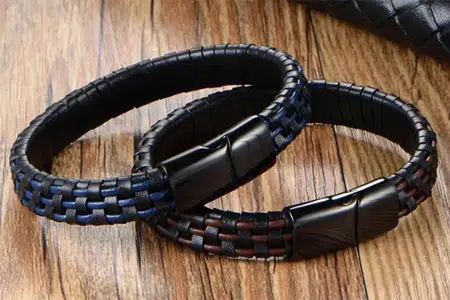
Factor 1: Hydrolysis Resistance
Cheap PU when the moisture in the air reacts with it. This is called hydrolysis, and the result is the following surface problems that you’ve probably seen with your own sight: peeling, flaking edges, and sticky surfaces after a few months’ break.
Hydrolysis-resistant PU has additives that prevent the absorption of moisture. This is important for you because it can sit in your warehouse for 8-12 months without degrading. A cheap PU that looks great when it comes out of the factory may start peeling before it ever gets to the customer’s wrist.
Factor 2: Coating Thickness
The thickness of the polyurethane layer determines how well the surface resists wear from everyday activities. Like with paint on a wall, one thin layer can easily be chipped, but three thick layers will last for years.
Fast fashion bracelet coatings are 0.3 mm thick, while jewelry PU’s are 0.63 mm to 0.01 mm thick. The extra thickness prevents cracks from showing on the Paris part when the bracelet flexes, prevents color fade, and maintains a smooth surface.
If you’re wearing a braided leather bracelet every day, it means flexing your wrist thousands of times. In a week or two, some thin coatings will start to crack.
Factor 3: UV Resistance
Sunlight damages PU leather through oxidation. The ultraviolet component damages the chemical bonds within polyurethane, causing fading, cracking, and increased brittleness.
UV-stabilized PU features additives that provide it with UV protection. This is a must if you present bracelets in a shop window or similar. If not protected from UV rays, PU will start to yellow within a few months.
A leather bracelet that has been hidden in the dark for 6 months versus one that has not been displayed in the store. The difference is night and day.
Factor 4: The Base Fabric
The PU coating is only as good as the base it’s applied to. The fabric provides rigidity, flex, and tear strength.
Low-priced bracelets are usually made of loosely woven thin fabrics that stretch out easily and wear out with time. Delicate jewelry has a backing that is either reinforced with a dense polyester weave or layered cotton blends, which makes the bracelet difficult to stretch when pulling or causes it to snap at the stress points.
The majority of failures were due to an inadequate performance of the fabric base rather than the PU coating failing. The backing – it’s unseen but essential.
Factor 5: Interaction with Stainless Steel
The PU leather can be ruined by metal parts due to chemical reactions with them. Ordinary steel will simply corrode when exposed to sweat and humidity. The latter rusts and forms very acidic compounds that corrode the coating when they come together.
304 stainless steel is rustproof. It is advisable to check the grade of steel used by the manufacturer whenever you come across a magnetic leather bracelet or a design with metal clasps.
Factor 6: Usage Environment
A bracelet worn regularly by a client who sweats a lot each day in a humid environment would last about 2 years, but if it were only worn occasionally by someone in a dry region, the bracelet would last approximately 5 years.
Water exposure is also important: While PU has greater resistance to moisture than genuine leather, the repeated soaking of a PU bracelet will still damage the product. Human sweat contains salts and acids; they eventually “eat away” at the protective coating on PU bracelets.
Clothing, watch band, and desk surfaces create friction, which ultimately wears off the surface coating of a bracelet. A person who spends most of their workday at a computer will subject their bracelet to much more wear than someone who does not.
The “Peeling” Problem: Why Some PU Fails Early

Returns result in wasted time and money for the company, yet still cost the customer money in return shipping fees, replacement shipping fees, and a bad reputation.
Fast fashion PU (1-yr) is generally composed of a sheet of very thin plastic, about 0.20-0.30 mm thick. Because the base (fabric) is weak and loose, and there is no hydrolysis resistance, the Fast Fashion PU coating will only last 6-12 months before it peels off. The thin PU bursts from thousands of flexes every day.
Jewelry Quality PU (2-5 yrs) has a stronger base (fabric) and a thicker (.60-.90 mm) layer of flexible plastic to keep the layer bonded to the substrate and from cracking when it is bent. Additionally, hydrolysis inhibitors extend the life of the jewelry-quality PU.
The wrist undergoes approximately 5,000-8,000 flexes per day (as a result of gestures, lifting, typing, etc.) Averages would be approximately 1.8 – 2.9 million flexes on a wrist per year. A thin PU coating can’t survive under these conditions, but a thick flexible coating can.
Storage Tips: Maximizing “Shelf Life”
Storing your stock properly ensures it continues to look as good as new for over a year! The following will keep your stock looking good:
Location and Temperature of Proper Storage
- Must be kept in cool storage areas between 15 to 25 degrees Celsius (59 to 77 degrees Fahrenheit)
- Must be kept away from extreme temperature variation (such as in a basement) and the heating and cooling ducts
- Should be kept away from air conditioner and heater heating registers.
Protection from Light
- DO NOT allow your products to be exposed directly to sunshine
- DO NOT store under fluorescent lighting that produces bright light immediately
- Store with an opaque or dark-colored box for long-term storage.
Humidity Levels
- Aim for a relative humidity of 40 – 60%
- Humidity levels too dry will cause cracking, while humidity levels too high can cause hydrolysis
Packaging Options
- Always keep individual bags of bracelets to avoid rubbing together and causing damage
- Do not put heavy boxes on top of bracelets stock.
Managing Your Customer’s Expectations: The PU Leather Bracelet Advantages
It’s vegan-friendly. No animal products are used in the manufacturing process. This is important to the growing population.
No conditioning needed: Unlike genuine leather, PU does not require oils or conditioners to keep it flexible and supple.
Water stain resistant: Water doesn’t stain it like it does with real leather. It is okay for light rain or to wash it with your hands. This is very attractive for bracelets that men wear every day.
Color consistency: Real leather can be different shades from different batches. PU is produced with the same color every time.
Realistic lifespan: Establishes a 2-3 year expectation when worn daily, while this can be stretched to 4-5 years for occasional use.
Conclusion: The ROI of Quality PU
No PU leather is the same; there’s a world of difference between something made to be disposable in 6 months and something that lasts 3 years. Choosing a manufacturer who provides hypoallergenic, hydrolysis-protected coatings and tear-resistant, waterproof substrates on 304 stainless steel fittings ensures your product lasts.
OOTB jewelry creates 2-5-year durability leather bracelets because we understand your business needs the quality to last beyond the initial transaction. Contact us to get a unique leather bracelet catalogue to choose from.
FAQs
Is PU Leather Toxic?
No. Quality PU leather is tested for skin contact safety and meets international standards. The polyurethane used in jewelry-grade items is the same material used in medical equipment and children’s products. Good manufacturers test for lead, cadmium, phthalates, etc.
 English
  French
  Spanish
  German
  Russian
  Turkish
  Portuguese